Secret 1: Successful CEOs aren’t busy – they’re focused.
“You cannot overestimate the unimportance of practically everything.” ― Greg McKeown
I know. You’re busy. You're trapped in the hamster wheel, answering email after email and barely keeping up. It’s hard enough managing just a few people—the idea of running an entire organisation seems impossible.
Here’s the secret: CEOs aren’t busy. They’re less busy than you are right now. They know the secret to success isn’t how frantic they are – when they become frantic, performance suffers.
In Michael Porter’s groundbreaking CEO study in 2006, 27 CEOs of large businesses were followed for a full 13 weeks—and the results were surprising. They discovered that CEOs are extremely agenda-driven, spending almost half of their time on activities that furthered their big goals—some up to 80%.
The most successful CEOs connected with senior leaders, providing useful strategic direction and monitoring the wider health of their organisation and culture rather than getting trapped in the nitty gritty. Rather than working double-digit hours seven days a week, they worked, on average, nine hours per day, being careful to make space for personal well-being.
This space isn’t a luxury; it’s critical behaviour for sustainable success that doesn’t lead to burnout. Twitter CEO Jack Dorsey echoes this sentiment on an episode of The Boardroom: Out of the Office podcast.
“I would rather optimize for making every hour meaningful – or every minute meaningful – than I would maximizing the number of hours or minutes I’m working on a thing.” - Jack Dorsey
Instead, Dorsey focuses on making space for meditating, exercising and learning throughout his day.
Focus isn’t about doing more. It’s about eliminating all the things that don’t serve the big picture. When Steve Jobs took Apple back over in the late 90s, he knew what to do. At the 1997 Worldwide Developers Conference, Jobs famously addressed the crowd to discuss the importance of focus. Jobs was clear: focus is not about willpower and discipline but the courage to say no to what isn’t the most valuable use of time and effort. That year, Jobs overhauled how Apple worked, eliminating all non-critical ideas, projects and initiatives to direct energy to the most valuable and high-potential business lines.
“People think focus means saying yes to the thing you’ve got to focus on. But that’s not what it means at all. It means saying no to the hundred other good ideas that there are. You have to pick carefully. I’m actually as proud of the things we haven’t done as the things I have done. Innovation is saying ‘no’ to 1,000 things.”
- Steve Jobs
Your next step
Channel focus and say no.
What to read
Essentialism:The Disciplined Pursuit of Less, by Greg McKeown.

Secret 2: Successful CEOs aren’t right, they’re ready.
“There's no harm in hoping for the best as long as you're prepared for the worst.” Stephen King
The pressure to get things right is immense. In an operational role, accuracy counts for everything, and many misguided leaders take this approach into more senior roles, panicking about their capacity to predict the future and make the right calls.
This pressure is unsustainable. When you’re responsible for the big picture, your planning horizon makes it extremely risky to predict all the variables.
Never fear: successful CEOs know that detailed and operational business planning is generally a waste of time. As you plan how long something will take and the precise steps to achieve a goal... it will change.
Rather than spending weeks and months planning detailed steps, successful CEOs nail their long game, set up the right conditions for success, and prepare to tackle unexpected issues.
Rather than waiting for perfect information, the most successful leaders focus on decisiveness and direction.
Jerry Bower, CEO of the private-label manufacturer Vi-John, uses a 65% rule:
“Once I have 65% certainty around the answer, I have to make a call.” - Jerry Bower
Instead of focusing on accuracy, Bowe hones in on impact. “I ask myself two questions: First, what’s the impact if I get it wrong? And second, how much will it hold other things up if I don’t move on from this?” Using this approach, Bowe frees up his time to focus on the big picture as far as possible.
The data backs this up. In the longitudinal CEO Genome Study, published in 2017 with ten years of data, the authors were clear:
“Our analysis suggests that while every CEO makes mistakes, most of them are not lethal. We found that among CEOs who were fired over issues related to decision making, only one-third lost their jobs because they’d made bad calls; the rest were ousted for being indecisive.”
Your next step
Understand your big picture.
What to read
Vivid Vision: A Remarkable Tool for Aligning Your Business Around A Shared Vision of the Future by Cameron Herold
Secret 3: Successful CEOs aren’t good communicators; they’re good connectors
“The single biggest problem in communication is the illusion that it has taken place.”
– George Bernard Shaw
Your communication skills have been critical to your success so far. Crafting the right message, saying the right thing, and building the right relationships are important at all levels of the professional ladder - but to take the step toward CEO communication isn’t enough. You need to become an influencer who can shape people’s thinking and behaviour.
Successful CEOs know that it’s not what they say that counts – but how they connect with others. When we confuse influence with talking people into things, we focus on reports and slide decks. But that keeps us focused on ourselves. Real progress comes from the power of connecting with others.
In Lead the Room: Communicate a Message that Counts, leadership communication expert Shane Hatton explains this clearly: with communication, we get engagement and with connection, we get trust. With influence, we drive change.
Ineffective leaders focus on popularity and try to get everyone on board, exhausting themselves and bending in every direction to keep everyone happy. However, the most effective CEOs know that quality beats quantity every time. True change doesn’t rely on everyone getting on board but inspiring tribes of committed followers to make things happen.
Seth Godin, author of Tribes: We Need You to Lead Us, spells this out plainly:
“…great leaders don't try to please everyone. Great leaders don't water down their message in order to make the tribe a bit bigger. Instead, they realize that a motivated, connected tribe in the midst of a movement is far more powerful than a larger group could ever be.” - Seth Godin
Howard Schultz, CEO of Starbucks, has known this from the beginning. When he pitched his concept of Italian-inspired cafes to the company's founders, he was met with resistance. He had over 200 no’s before finally proving his concept could work. He credits much of his success to building a powerful team, treating them with respect, and instilling faith in the big picture.
"When you’re surrounded by people who share a passionate commitment around a common purpose, anything is possible."
- Howard Schultz
Your next step
Identify who you need to reach – and what you want them to do.
What to read
Influence: The Psychology of Persuasion, by Robert C. Cialdini.

Secret 4: Successful CEOs don’t know more; they ask more
"We thought that we had the answers, it was the questions we had wrong." - Bono
The old path to leadership depended on your expertise. Years spent accumulating knowledge at university are compounded by more years of doing your job well.
With the explosion of knowledge work and the increasing complexity of modern business, it’s not quite this easy anymore.
Most CEOs lead complicated teams of people who know more about their jobs than they do—and rightly so. The more senior you are, the more you’d have to know for this model to make sense. No one expects the CEO to be a marketing whiz, IT guru, legal boff, or technical expert.
As an expert, your job is to have the answers, but as CEO, your job is to ask the right questions and empower your team to find the answers. Don Yager, chief operating officer of cloud tech company Mural Corporation, famously asks his frontline team: “What are our policies that suck?” The power of a question with humility and openness shifts the inherent power dynamic between leader and follower, making it possible for people to contribute their knowledge and be honest about what needs to shift.
In “Questions Are the Answer: A Breakthrough Approach to Your Most Vexing Problems at Work and in Life,“ MIT Leadership Center executive director Hal Gregersen outlines his findings, providing that the world’s most successful companies are led by people who ask ‘catalytic’ questions to drive progress.
“These questions not only challenge false assumptions in the system, but they give people the energy to do something about it,” Gregersen said. “When you think of Rose Marcario, Marc Benioff, Jeff Bezos, Elon Musk, any of those folks, they systematically, habitually create conditions where they themselves are likely to be wrong, uncomfortable, and reflectively quiet, such that a question would emerge that they otherwise wouldn’t ask.” - Hal Gregerson
Eric Schmidt, former CEO of Google, echoes this sentiment. Schmidt is the first person to admit that he wasn’t the best software engineer out there, but that wasn’t what he was hired for. His constant curiosity and willingness to question assumptions—and be wrong—impressed the people he worked with.
Jonathan Rosenberg, who worked with Schmidt, says: “He's very smart and constantly thinking about how the world is changing, how industries are being disrupted, and how to change the way he manages every day."
“We run this company on questions, not answers.”
- Eric Schmidt
Your next step
Ask better questions.
What to read
Good Leaders Ask Great Questions: Your Foundation for Successful Leadership by John C. Maxwell

Secret 5: Successful CEOs aren’t tough; they’re flexible.
“Notice that the stiffest tree is most easily cracked, while the bamboo or willow survives by bending with the wind.”
- Bruce Lee
The old perception of a CEO was an impenetrable fortress, staunch in the face of adversity. Former military leaders graced conferences to discuss their discipline and determination, while new CEOs were handed a copy of the ‘Art of War’ to get them on the right track.
Oddly, this perception was never really accurate – but now, we know that’s not the case. In a fast-changing and complex business environment, CEOs handle trickier change than ever.
Today’s leaders are expected to account for different pressures—environmental sustainability, social responsibility, economic uncertainty, technological advancement, and legislative change, to name a few. Juggling this ambiguity and delicacy doesn’t call for military-style toughness and order—it asks for flexibility.
Deloitte’s 2017 CEO research, which tracked the behaviour of 24 global Fortune 250 CEOs, saw researchers ask the question: “What does it take to be un-disruptable today, and what will be demanded of CEOs and their organizations to avoid disruption tomorrow?”
They found that today’s CEOs stressed the importance of embedding constant exploration, experimentation, and improvement at every stage of their decision-making process and value chain.” Their success wasn’t about their ability to toughen up but about building confidence in changing tack, taking risks, and innovating while cultivating confidence in possible failure.
Salesforce CEO Marc Benioff underscores the importance of this agility, actively building the same attitude in his teams. “I respect the spirit of innovation,” Benioff says.
“Sometimes that spirit is going through me and sometimes it’s going to come through someone else … I try to cultivate a beginner’s mind; I try to let go of all the other things that have ever happened so far in our industry (which is a lot of stuff) and go, ‘Okay, what’s going to happen right now?”
- Marc Benioff
When Mary Barra assumed the helm at General Motors, she scrapped many of the stuffy old policies at the century-old company – famously shortening their old 10-page dress code down to just two words: “Dress Appropriately” – to work on building an organisation that was comfortable with taking new directions.
Rather than doubling down on its traditional business model, Barra has made huge shifts, investing in areas as diverse as insurance, electric vehicles, self-driving cars, and ride-share services. With Barra at the helm, GM has ushered in a new approach to old problems, as she empowers the team to innovate, operate independently, and embrace the challenges of climate change and a changing social context with both arms.
“In this area of rapid transformation, you have to have a culture that’s agile”
- Mary Barra
Your next step
Cultivate your capacity for change
What to read
Mindset: The New Psychology of Success by Carol Dweck
TL; DR
If you want to be a CEO, stop trying to know everything, do everything and project a slick and perfect exterior. Instead, work on the five most critical skills of the world’s game-changing leaders.
- Be focused, not busy
- Be ready, not right
- Be a connector, not a communicator
- Be an asker, not a teller
- Be more flexible, not tougher.
Your next step
Pick one of these areas to focus on.
What to read
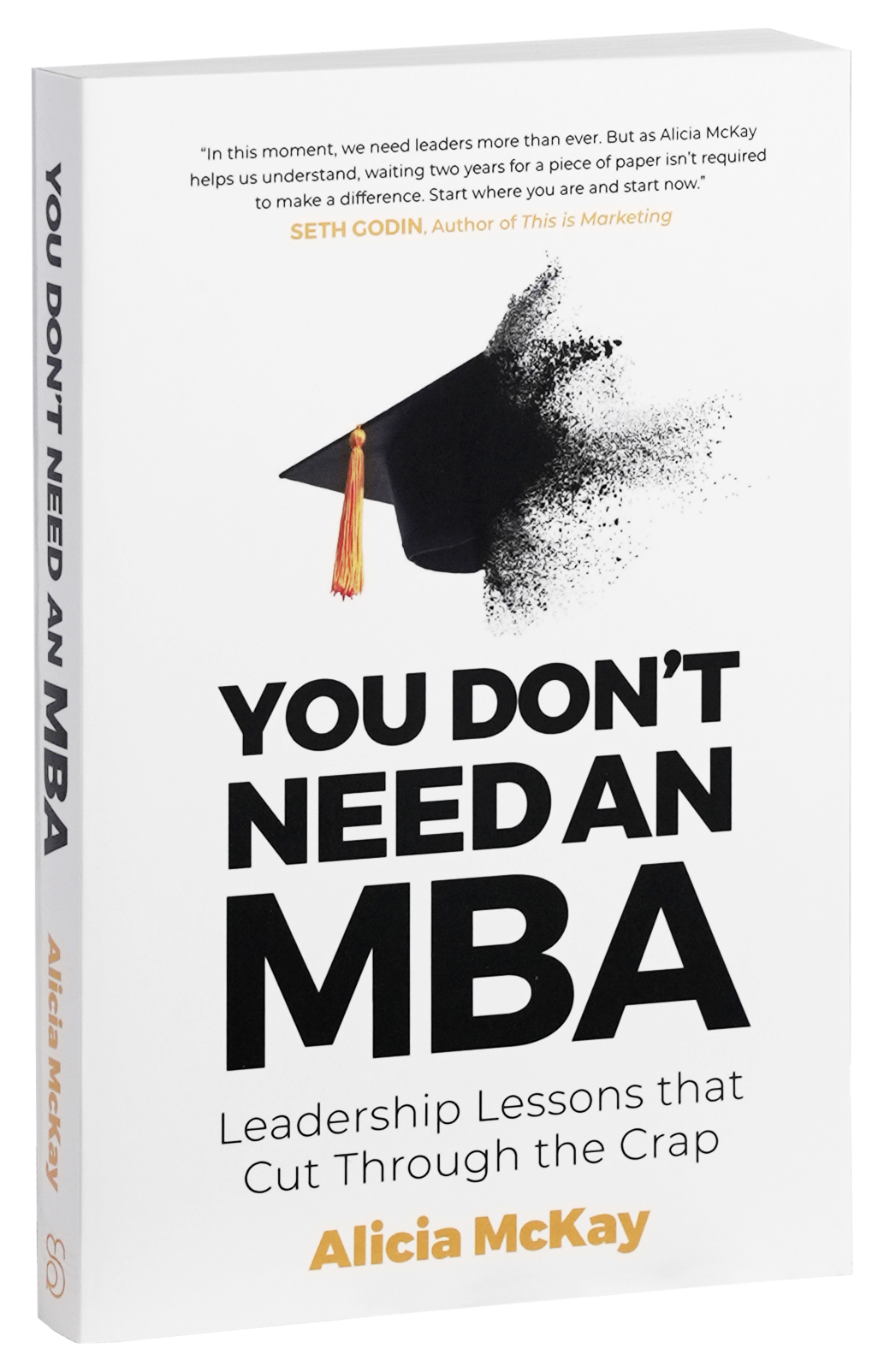
You Don't Need AN MBA: Leadership Lessons that Cut through the Crap by Alicia McKay
 Alicia McKay