
 Think for yourself
 See more clearly
 Make better decisions
 Live on your own terms
 Speaking
 Training

Welcome to Friday Flurry. This fortnight features intense and contradictory musings about burnout, agency, and attitude. Are we the masters of our own destiny? Is the world going to do what it does regardless? Can you choose your environment... or is the game rigged? Also featured: ancient poetry, book recommendations, and surprising research about how your neighbourhood changes you. But first, let me tell you how tired I am...
Hi gang,
Hope you're surviving out there. Spring has sprung, which in Wellington means an even split of gorgeous fresh sun and pissing grey rain. That's Mother Nature's signal to cast off the seasonal depression that feels like a total coincidence every year and begin the march toward Christmas. Huzzah.
A friend told me this week we are "heading into the burnout part of the year." That jives with my vibes. I'm heaving through the week like a hormonal hippo, blinking with surprise every time another day starts and I'm expected to participate in it. I'm putting things down and instantly forgetting they existed, juggling an endless stream of appointments, navigating kid stuff (balls, exams, playdates, sensitive adolescent crises, et al), making end-of-reno judgement calls (who knew a toilet roll holder could be so important?) and generally trying to be a person in the world and stay alive. Oh, and I'm about to go on the road for a full-on week of travel and delivery. The struggle is real.
All this beleaguerment is either a complement or a contradiction to the smorgasbord of ideas I'm plating up in this fortnight's Flurry. You decide.
Are you the master of your own destiny?
Battling waves of burnout and pressure, I've been rolling around some big and conflicting thoughts.
- None of this is up to you. Your future is uncontrollable and the externalities determining it are too powerful for you to take responsibility for. Embrace your limitations, love your fate, and do what you can without shame, judgement or consternation.
- You have total agency over your life and future, and most of your constraints are self or socially imposed fiction. You should do whatever pleases you because few people give a damn and the consequences are rarely as dire as you expect.
- Your context shapes your possibilities in ways you can hardly grasp. Be cautious of the environment, people and ideas you spend your days marinating in.
- The game is rigged. No matter what you do, some games remain unwinnable. You can't fight structural forces with self-help.
I argue all four positions in this mega-Flurry. It goes wide, goes high, gets bleak, and argues against itself. Make a cuppa and get a nice snack. I can't wait to hear which of these four lenses hits for you right now - especially if you've been feeling the weight of things, too.
1 - None of this is up to you
I'm reading Oliver Burkeman's Meditations for Mortals, a peppy little book of ideas for over-functioners (🙋🏼♀️). It's structured in 28 chapters/days and builds on themes from Four Thousand Weeks. Burkeman urges readers to embrace their inescapable finitude, let go of a false sense of control and stop waiting for things to be perfect to do things that matter to you.
My favourite part is an epigraph Burkeman includes at the start of Day Seven ("Let the future be the future.") This poem moved me so profoundly I read it to close the final session of Not An MBA 2026.
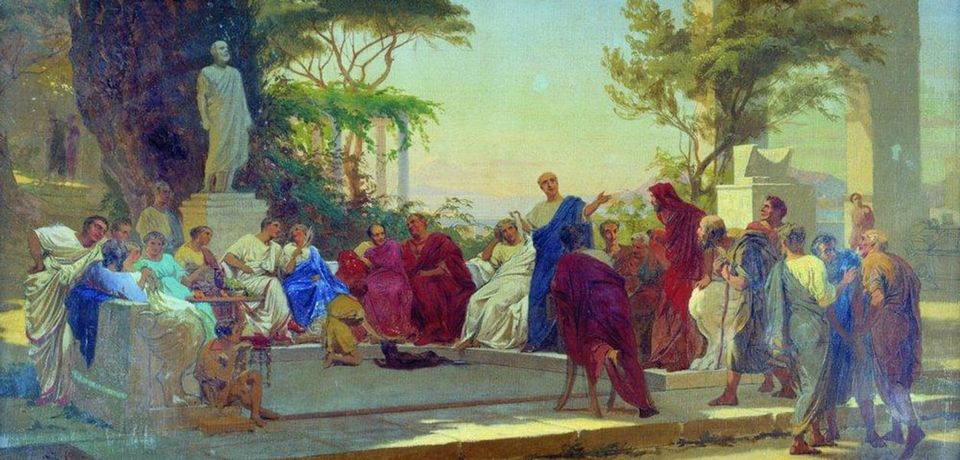
Don’t waste your time, Leucónoë, living in fear and hope of the imprevisible future; forget the horoscope. Accept whatever happens. Whether the gods allow us fifty winters more of drop us at this one now which flings the high Tyrrhenian waves on the store piers, decant your wine; the days are more fun than the years which pass us by while we discuss them. Act with zest one day at a time, and never mind the rest.
- Horace, Odes, Translated by Derek Mahon
The passage is from Horace's Odes 1.11, a poem where he coined the legendary phrase carpe diem - seize the day. The full line is much cooler than the oft-quoted fragment. Carpe diem, quam minimum credula postero literally translates to “Pluck the day, trusting as little as possible in the next one.”
This book of poems (a series, Odes 1-3) wasn't successful when it first published. It wasn't until years later when Emperor Augustus commissioned a fourth instalment that the series took off and eventually spawned a whole tradition of ode writing over 1500 years later. Art, man. Sometimes it takes a while to hit.
Horace (fully: Quintus Horatius Flaccus) was a Roman poet born in 65 BC. He was a chatty, cheeky writer who would have killed on social media. He managed to pull off the "blame poetry" form (iambic poetry) without specifically naming targets, which is ancient VagueBooking genius.
Writing plainly and wittily, he dropped other such bars as "You can drive nature out with a pitchfork, yet she will always hurry back." (He also wrote obscene, misogynistic, aggressive poems targeting women, so, y'know. Scratch far enough under the surface of history and there's always a rich famous dude who got away with being a jerk.)
Anyway. Horace's themes were very much about letting what will be, be. This is the thinking of tons of philosophical schools - Stoicism, fatalism, determinism, absurdism, et al. The guts is: don't be so arrogant as to think you're in control of the universe, and assume most of what happens to you would have happened either way. Release control. Surrender. Amor fati - love your fate. Etc.
There's real comfort in this. If you stop tangling yourself up in knots trying to control everything, you can be a whole lot nicer to yourself if your life isn't what you hoped. I can think of six or eight things a day I should have this kind of equanimity about. Solid approach.
But.
There's a certain futility in this thinking that I don't love. Like, sure, the world is too big, fraught and chaotic for one person to stay across and be the boss. But when we give into the prospect of inevitability, we don't just surrender our stress, we risk losing our sense of agency. Which leads me to the second perspective I'm chewing on.
2 - You have total agency
Almost everything that meaningfully defines your current daily circumstances - your job, family, place of residence, peer group, hobbies, and so on - is the result of a choice you've made. We decide what to study, where to live, which job to take, who to hang out with, and what to do with our time. Then, every day, we get up and make those choices all over again. We function in the world on our own volition.
Adulthood is an ongoing commitment to choices nobody forces you to make. Your Mum isn't going to make you get dressed, brush your teeth, or go to work. You're not a prisoner. You don't have to do anything. If you want to watch TV all day and have ice cream for dinner, that's up to you (and Child You is baffled you're not doing that, by the way.)
We build ourselves cages, then line them with trappings. We furnish them with bills, families, employees, roles, houses, possessions, schedules and goals... then we act as though these things were imposed on us, forgetting that every one of them was something we chose. Our kids didn't ask to be born. Our bosses didn't draft us like soldiers in wartime. Our homes didn't buy themselves.
I just read a book on this very topic: You Can Just Do Things, by Cate Hall. Hall is a serial life-blower-upper who left her lucrative law career to become a successful poker player. She gave that up when she slid into the grips of addiction, and post-rehab she co-founded a biotech company, before becoming a philanthropy CEO. It's a hell of a story, and though I expected her book to be more of the American ra-ra motivational shit cluttering airport bookstores, I was pleasantly surprised.
Hall writes about being high-agency. Agency, she writes is "the capacity to both see and act on degrees of freedom that other people overlook." I don't know about the needless competition baked into that definition, but I strongly agree there is usually more options available than we first perceive.
Hall, too, writes of cages. Of her law career: "I was the kind of bored that makes caged animals stop eating. But I was still scanning the perimeter of the cage, looking for a slightly more comfortable corner - not a way out." I highlighted this one. That's the guts of it, isn't it? Even when we want to change, we try to find a way that doesn't require giving anything up. We're not stuck, just blinded by self-protection.
Hall's prescription isn't complicated, or even particularly novel. If we're willing to risk our trappings, look stupid, trust our capacity to cope with the consequences of our actions, and turn some of our old stories upside down, there's all kinds of stuff we can do. We need to stop pretending there's only one way to live, and that everything is too hard to bother, and start looking for ways to get what we want, because they exist.
In Meditations for Mortals, Burkeman quotes Sheldon Kopp, an American psychotherapist:
You are free to do whatever you like. You need only face the consequences.
It's not that we can't do what we really want to do, if we even know what that is. It's that we fear the consequences. You're a grownup, and if you want something, you can go get it. You'll just have to live with the fallout. This is agency. This is ice cream for dinner. This is adulthood.
Of course, there are problems with this too. You're not just a person living in a bubble. You're a family member, a leader, and part of a community. Your actions affect others. Blowing up your life (or your dinner plans) on a whim might be your prerogative, but it doesn't make it fair.
Plus, consequences don't hit the same when you're already living on the edge. If you're broke, trapped in an abusive relationship, sick, or constrained by caring responsibilities, your agency isn't the same as someone born into money and cruising around with no kids and full health. Still, no matter where you start from, you've got options about what comes next.
Neither of these ideas is useful taken to the extreme. One induces hopelessness, the other induces blind or selfish risk-taking. But a healthy dose of both, applied judiciously, feels useful.
Of course, you won't be able to take either of these ideas on board if you're breathing in the toxic mould of a shitty environment, which brings me to my third provocation.
3- Your context shapes your possibilities
Last year, I wrote a series on The Ambition Recession to explore a hunch about a general sagging and weariness here in New Zealand. Since I wrote those essays, things haven't gotten much better. In fact, I reckon things have gotten worse.
I opened this Friday Flurry whinging about how overloaded I'm feeling. This is almost every conversation I'm having right now. "How are you?" "Tired." "Same." Everywhere I turn, people are battling, broke, and burning out. The list of complaints is diverse, but the themes are all the same #FML energy. They've got too much on, but they're not moving forward. They can't charge more for their services, because nobody will pay. Their boss is a jerk. Their partner is unsupportive. They hate their job. They are stuck and sad and bleurgh.
This week, I ended a phone call and realised that talking to that person had made me feel worse about my own life - despite me not being the topic of conversation! After absorbing half an hour of complaints, sprinkled with criticisms and snarky comments about other people, my energy was sapped. My forehead was tense. The world took on a grey pall.
Remember that old idiom, about how you're the average of the five people you spend the most time with? It's not exactly true, but it's not totally off-base either. The network effects actually reach far more widely than just five people, extending to friends of friends of friends. Vibes travel and attitudes are contagious, not just in friendships and families, but across whole cultures.
In New Zealand right now, the energy feels contracted. It's small. It's a collective vision of about three weeks. It's self-fulfilling scarcity prophecies. It's the threat of impending job loss. It's negativity and no money and no options and can't go out, can't do this, can't do that, can't do anything. Listen to enough of this and it will crawl into your brain, soak into your thoughts, and suck away your get-up-and-go. You'll believe it, and then you'll make it true.
Of course, that might not be your experience. It might just be the people in my circle (and the people in theirs, and so on.) Because no matter how high-agency or individual we think we are, we are incredibly porous globs of meat building and rebuilding ourselves from the raw materials of the external world.
The people we spend time with - their aspirations, attitudes, habits, and lifestyles - frame our expectations for ourselves. The ideas swimming in our culture - the books we read, reels we scroll, news we consume - shape our understanding of what's possible and preferable. Our physical environments matter, too. How messy your house is affects your mood and sense of control. How social your public spaces are affects your relationships - down to how close you are to a highway and how long your nearest river is! (Source.) Placeshaping is a thing for a reason.
Which is all to say: it's hard to feel good about the world if you're in shitty surroundings.
The upside is that as a high-agency person who builds her own cage, while you can't necessarily change the world, you can change which parts of it you interact with. You can make your house nice, stop talking to people who drag you down and seek positive, high-energy, social spaces and relationships that unlock new ways of looking at the world.
You can put down the doomscroll and read a novel that touches your heart. You can go for a walk and breathe fresh air (watch out near those highways). You can learn about new things, read the stories of people who've lived unconventionally throughout history, put yourself in situations, take big bets on a vague long game, and open new doors to find out what's on the other side.
None of this is perfect, but it can be useful: acknowledge reality in its absurdity and bleakness, don't expect to be the master of the universe, and give your dreams a good nudge no matter what the negative nellies around you have to say because... fuck it. You only get one life. Do with that what you will.
I toyed with the prospect of leaving this Friday Flurry here. A few years ago that might have been enough for me - as a reader, or as a writer. But there's a nagging at me that won't go away, a tugging I can't shake off. That feeling peaked on Monday.
4 - Some games are rigged
On Monday, I came home from a research session at the National Library barely able to speak for how overwhelmed I was. I'm researching the history of motherhood and childbirth for my novel, and had just finished Sue Kedgley's Mum's The Word: The Untold Story of Motherhood in New Zealand. I took copious notes, and by the end I couldn't read them as my eyes blurred with tears.
The book tracks motherhood in New Zealand from the 1880s. It traces the lives and experiences of mothers from a time when there was no legal protection at all - when husbands owned their wives, children, and all of their property - through to 1996, when the book was published. It tracks shifting social norms, laws, education policy, birthing practices, and expectations of mothers across over 100 years - and all the social movements that brought liberation over that time. And what liberation there has been!
From an average family size of eleven, to a contraception pill and eventually, legal abortion. From coverture to no-fault divorce and relationship property division. From being trapped for life in abusive marriages or impregnated by their employers and forced to adopt their babies out to having sole parent income support from the state. From mandatory home science classes at school to equal participation in the workplace. This is all great news... and yet.
Once the pill was available, mothers were shamed and framed as selfish threats to the national future. Once divorce (and, more importantly, child support) became an option, women who managed all the domestic and household labour with no help from invisible husbands were called home wreckers and accused of taking kids from their fathers. Once the DPB came in, women were relentlessly surveilled by state agents to make sure they didn't eat dinner with a man, called sluts, told to put their kids up for adoption, and blamed for the downfall of society - by politicians, no less. Once mothers were able to work, they were called lazy for staying home - and also, somehow, selfish for working. In the 30s, mothers were told they were inept and instructed to follow a strict "scientific" approach to childrearing that ignored their hungry babies and undermined their emotional connection. In the 60s, they were castigated for their coldness and instructed to practice attachment parenting, never putting their children down for a moment. They were shamed for breastfeeding with their sexy boobs, and panned for bottle-feeding with their lazy bottles. Once, women had a 2 week hospital stay after birth - but they were only allowed to see their babies when nurses brought them in. Now, they can room in - but they're booted out of hospital a day after giving birth.
The book closes 30 years ago on a hopeful note - though with some noted reservations about how hard it was becoming for mothers to manage increasing expectations on them socially, professionally, and at home. Glad we sorted that out since then!
As I reached the end of the book, it was clear that for every liberation, there was a new trap that sprung up in its place.
In 1975, Ruth Adam wrote in A Woman's Place:
"A woman born at the turn of the century could have lived through two periods when it was her moral duty to devote herself obsessively to her children, three when it was her duty to society to neglect them; two when it was right to be seductively 'feminine' and three when it was a pressing social obligation to be the reverse; three separate periods in which she was a bad wife, mother, and citizen for wanting to go out and earn her own living, and three others when she was an even worse wife, mother, and citizen for not being eager to do so."
Things are far better for women of today than 30, 50, or 100 years ago. The wages are better. The misogyny is more covert. We have washing machines. Our share of the domestic labour has dropped to 70% - (except if we earn more, then we tend to do more at home. Make it make sense.) Yet 1 in 3 women still experience sexual assault and 90% of those go unreported. Few result in a conviction and those that do entail months or years of doubt and trauma. There is still a glass ceiling, glass cliff, and sticky floor built into our work architecture. Not to mention, the latest social trends that keep women feeling like failures - i.e. Do all this, and also have hobbies, and be hot and sexy, but in a way that's appropriate, and earn all the money, and look after everyone's feelings, and also freeze your face and don't age and lift weights and be strong and relax and do self-care and go out and have fun but not too much because that's selfish and have kids because it's your biology but if you do that's your own fault and above all, be nice, be so, so nice, all the time. It's hard to feel like there's an option that comes without the catch.
So yeah, look. You can have the right attitude: the serenity to accept what you can't change and the agency to bust through self-limiting beliefs and create a good environment for yourself. Go for walks. Journal. All that jazz.
You can even transcend your individual concerns and become a change-maker for the collective good. You can resist and lobby and protest. You can push for law change and even get those law changes enacted and decry violence against women and non-regulated tech monopolies and climate catastrophe and corruption and racism and precarious working conditions and sneering politicians and and and and and... Then what? Another trap. Another way to lose. We can fiddle with the settings and rearrange the deck chairs all we like, but structurally, those same power dynamics that had our colonial grandmothers trapped are with us now, and did I mention I'm so fucking tired?
Some constraints are so structural, so load-bearing, so old, that they're able to transform and shapeshift every time we defeat them. For those ones, we can accept our fate, cultivate our agency, and curate our environment all we like, but we can't opt out of our position in society or place in history. That shit is rigged.
...Where did you land?
Til next fortnight,
A