
 Think for yourself
 See more clearly
 Make better decisions
 Live on your own terms
 Speaking
 Training

In 2000, psychologists made a bunch of self-conscious Cornell students walk into a room full of their peers wearing a Barry Manilow t-shirt. When asked, they predicted about half the room would clock their crappy fashion - but fewer than a quarter did. Researchers call this the spotlight effect.
The spotlight effect is a phenomenon where we massively overestimate how much other people notice us: our outfits, our stumbles, and our changes of heart. The truth is closer to what your Mum probably told you: people are too worried about themselves to notice much about what you're doing.
The original study was a quarter of a century before social media slid into our mental DMs, turned everyone into a personal brand, and messed up our perception even further. A 2023 study out of Oregon State University found that when we get attention after posting online, we become more egocentric - which makes us even worse at judging how much attention people pay to us offline. And heavy social media users are the worst at it. Colour me surprised, and spare a thought for our poor self-conscious teens marinating in InstaHell.
Put it down, pick it up
In 2024, I put Not An MBA on hiatus. I'd run three cohorts a year from 2021, plus large-scale enterprise programmes, and I was cooked. I needed a break. I made an announcement, ran a final cohort, and put it on ice for two years. Then, in 2026, I brought it back. I was a bit nervous - would people think I was flaky? Would my reputation be shot? You will be unsurprised to learn that most people hadn't noticed, and potential students were just stoked to have a new chance to enrol.
After I announced the 2027 cohort dates last week, I chatted about this with a friend. She's changing her business model and was worried that if she made the wrong choice, all her hard work would disappear. "Your naMBA hiatus is a great reminder to me that nothing's permanent," she confided. Bang on, babe. Putting something down doesn’t mean it’s gone. It’s just not this season’s job.
I love changing things. Yesterday, I reorganised the lounge. My table is facing a different direction, and my bedroom desk is having a holiday by the lounge window. In 2026, I trialled a 'sprint and rest' approach to my calendar. Now, I'm reviewing what I learned and preparing for something different. Earlier this year, I stripped my web presence back to a bare-minimum, writing-only approach. I introduced cool features like the reading log, member dashboard, and essay hub. This week, I've unveiled a new design that brings in more of my personality and service catalogue. The feast keeps moving. A few of you will click for a nosy, most of you simply won't care. So it goes.
These short-term choices and changes crop up in our lives all the time - whether it's which projects to put first, or how to structure our days and weeks. We try new hobbies, podcasts, and haircuts, then we do something else. If you've ever felt guilty about being a change junkie, don't. This is how we learn more about the world and ourselves, and adjust to new phases and pressures.
“A foolish consistency is the hobgoblin of little minds.” – Ralph Waldo Emerson
More importantly: if you feel trapped in a cage you made for yourself - a job that hasn't worked out, a relationship that sucks, or a hair colour that doesn't suit you - well, chill. Your CV gap is fine, you can meet someone new, and half your workmates haven't noticed the hair. Do what's right for you.
How strategy helps you change
Strategists know that plans are a fool's game - crystal ball predictions about an uncertain future that go out the window as soon as the ink's dry. Real strategic planning isn't about prediction. It's about preparing for the unexpected.
In my Strategy 101 model, there are three levels:
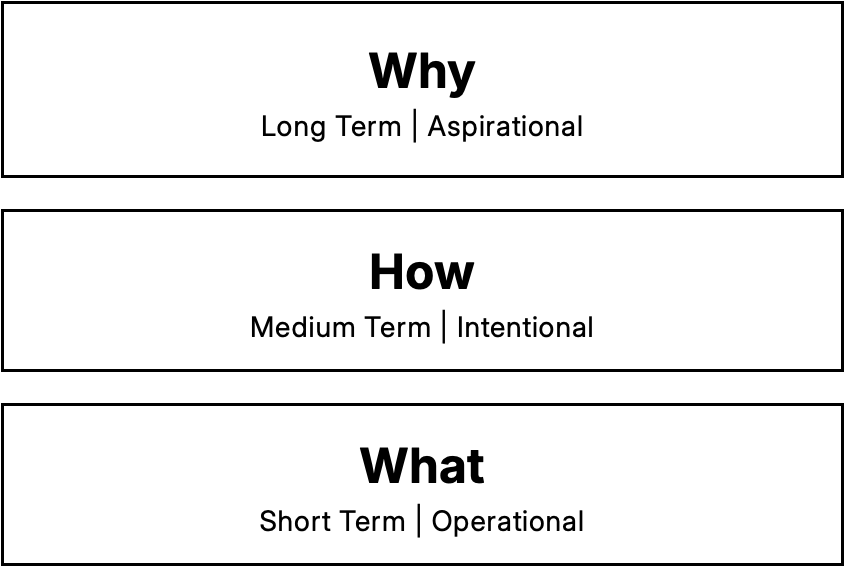
- Your why is the long game: your values, principles, and purpose.
- Your how is the design: the priorities and filters you use to make choices.
- Your what is the day-to-day stuff, like projects, plans, and to-do lists.
The why should rarely change. The how should last for a season. The what should change all the time.
Most of us get this ass-about-face. We clutch onto our whats like a life raft and let our whys go fuzzy. Then, when something unexpected happens, we’ve got nothing to steer by except the plan - which is already wrong. So we throw it all out the window, and flounder.
When you know what matters most to you, you don’t need much of a plan. You can make good decisions on the fly. That's what good strategy does - clarifies your why, sets your priorities, and gives you the freedom to do what's right.
You’re allowed to change your mind, learn something new and act on it, experiment, and grow. In a world where things are constantly shifting, you'd be mad not to. Besides, most people are too busy worrying about their own stuff to notice.
Til next week,
A