


In New Zealand, the government intends to reduce the size of the public sector: consolidating agencies, reducing head-count and making extensive use of 'AI.' Smaller, faster, and automated public service is assumed to be a) achievable and b) good. Both assumptions are dubious, but miss an important question: why?
We confuse government with business
It is a common foible to mix up the operations of the public service with those of private businesses. "You'd never run a business like this!" is a common refrain for all things government. This is correct. Government is slow, costly, and bureaucratic compared to many businesses.
Government offers services that businesses won't, or can't, under different conditions, for different reasons. Social services, healthcare, infrastructure, policy-making and all that good stuff is complex and unprofitable. (This is why privatising them rarely saves money and usually worsens outcomes.)
Government's job is far-reaching. It creates the conditions for a safe, supportive, and productive society, and safeguards social, economic, and environmental outcomes for current and future generations. Government coordinates the stuff we can't do on our own or through the market.
It's a hard job to pull off. The goals are big and many, resources are constrained, scrutiny is high, and meaningful impact is hard to turn around quickly. It's also a hell of a lot harder than running a business.
To explain why, we'll take a brief sojourn into strategy.
How strategy works
Strategy makes the most of the hand you’ve been dealt. It channels your limited resources toward a shared direction, which is particularly useful when there are lots of people and processes that need to work together. Done well, strategy guides daily decisions toward a long-term goal.
Strategy 101
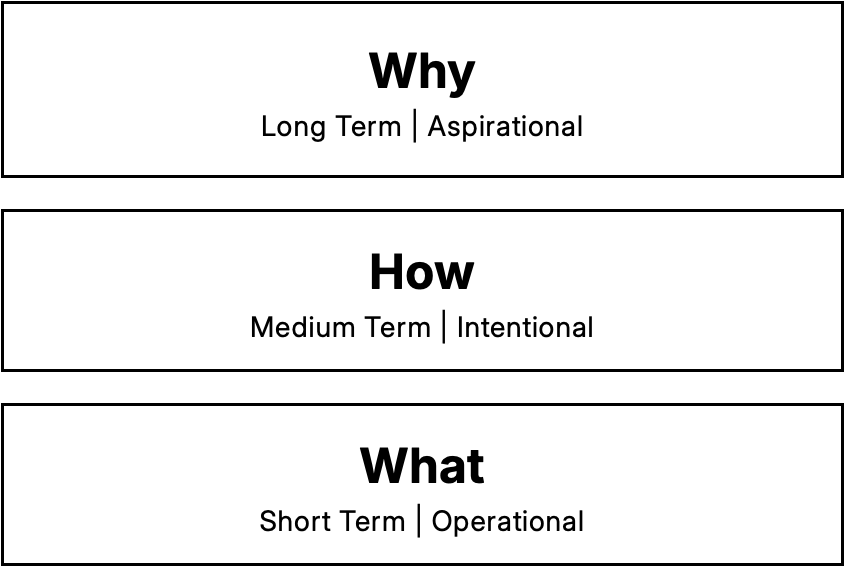
The model below outlines the three levels of strategy.
Why
The ‘why’ level is where you find jargon like purpose, vision, and mission. These are our aspirational long-term outcomes. When we’re clear on our direction, we can choose our path to get there. The ‘why’ level should rarely change.
How
The middle ‘how’ level is the guts of strategy, where you find jargon like objectives, priorities, and principles (or recently: 'pillars'.) This is where we set the medium-term focus that becomes a filter and lens to guide short-term choices at the 'what'. For most organisations, the ‘how’ level changes every three to five years.
What
The bottom ‘what’ level deals with planning, actions, and initiatives. These are the operational choices made in the short term: the daily proof of our commitment to long-term aspirations. The ‘what’ level changes daily, as it should, but it is guided by the 'how', in service of the 'why'.
The strategic differences between business and government
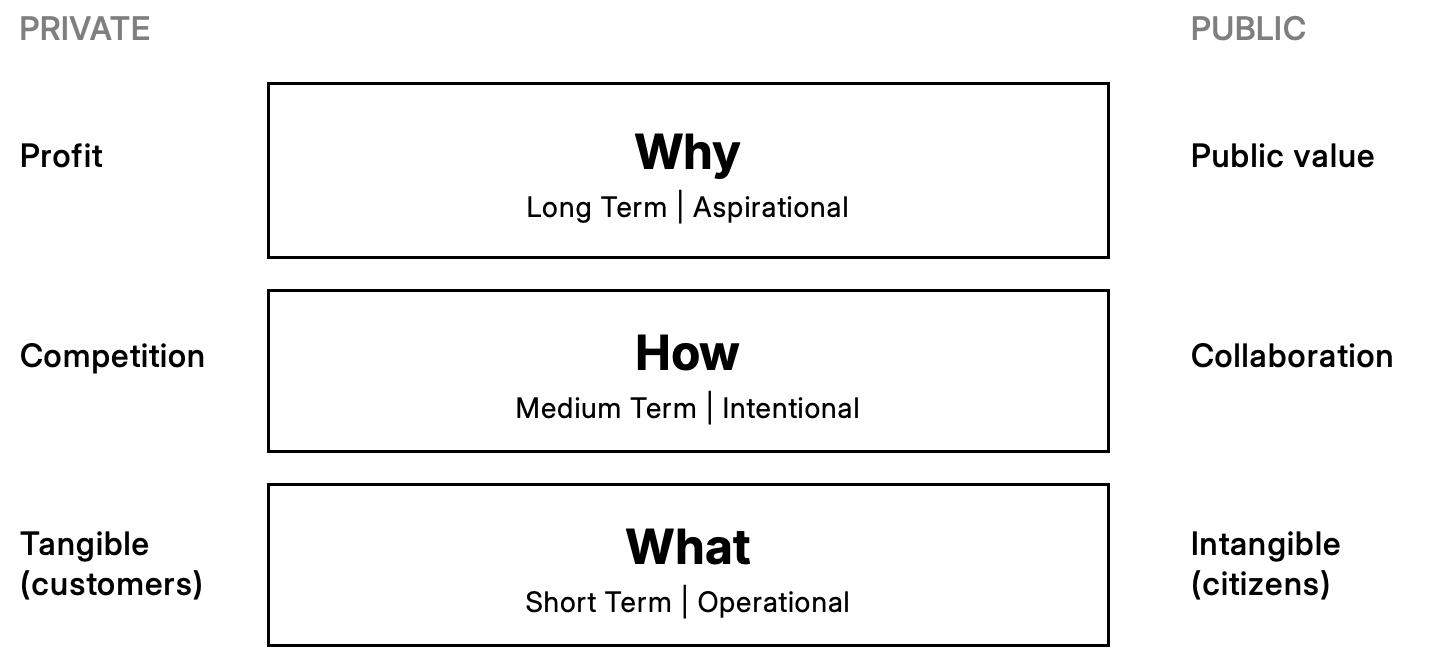
I've used Strategy 101 with public sector leaders all over the world - and with private companies in many industries. While the foundations are the same, the implementation is different, due to key differences at each of the three levels.
Why: Profit vs public value
The private sector’s ‘why’ is to make money. Businesses capture private value for shareholders as profit. This purpose informs all subsequent choices. If your purpose is to capture as much profit as possible, you design for precision focus, fast decision-making and cost minimisation. Non-aligned or low-margin products and services are removed, processes are made as efficient as possible, and labour costs are capped. Bing, bang, boom.
Government does not exist to make money. Revenue is used to fund services and investment, but is not captured privately. Instead, the public sector aims to generate long-term public value. Public value is a more complex outcome than profit - driven by different factors, harder to measure in the short term, and more ambiguous to define.
Public value considers the following four factors:
- Collective good. Everyone benefits - and it is difficult to exclude individuals from that benefit. This doesn't mean people benefit equally or directly. You might not personally need a passport, or go to the hospital - but you benefit from living in a society where you can get a passport, and a hospital is available.
- Leveraged impact. Much of what government does acts as a catalyst or baseline. Protecting property rights by law underpins the economy. Providing functioning infrastructure enables connection, travel, and lifestyle.
- Sustained effect. There is an observable and lasting shift in society or the community. This shift might be a service outcome, physical change, or intangible value shift, but it should stick around. We assume government will not make "good for now, bad for later" choices.
- Public values. Public value protects shared public values - often ‘higher order’ values, such as safety, justice, or health.
When businesses reduce costs or streamline operations, it is directly aligned with their purpose: to capture profit. When government reduces costs or streamlines operations, it is in service of a different purpose - to generate public value. We should see a link to more collective benefit, leveraged impact, sustained effects, or protection of shared values.
How: Competition vs collaboration
In the private sector, businesses differentiate to create a competitive advantage through design, pricing, quality, features, and branding. Their MO is to carve out a unique niche and defend it from competitors. In a competitive operating model, businesses aim for focused services, streamlined workflows and cohesive operating structures.
In the public sector, there is no competition. The government has a functional monopoly on libraries, roads, bridges, hospitals, and so on. There is no niche to carve out, and focus is difficult when the organising logic is "good stuff that needs doing, but no-one else will do, because it doesn't make any money."
Instead of competition, government is powered by collaboration. All significant decisions must be made in public, with the public, or both. This is inclusive, but not fast. Collaboration is a different operating model - but it's critical for democracy because of the relationship government has with it's citizens - more on this below.
What: Tangible v intangible
In the private sector, businesses serve individual customers. They provide tangible products and services that people willingly purchase. They make product and service decisions with their why (profit) and how (competitive advantage) in mind.
The public sector serves the collective – and not just with tangible goods and services. Government's intangible deliverables include ideas (strategies, initiatives) and rules (policies, regulations, planning guidelines). Some projects and initiatives don’t pay dividends for years or decades. With their why (public value) and how (collaboration) in mind, many of these services will lag, overlap, or conflict.
Who: Customers v citizens
Private sector goods and services are offered to people who decide whether to buy them. Companies choose who they serve, and how - and most successful business strategies narrow their customer base.
Public sector goods, services, and intangible offerings are not offered to willing customers so much as imposed on hostage citizens. Governments decide how much of people's money they're able to take, and what they're going to do with it. These decisions need to benefit a diverse range of people and groups.
In business, customers don't expect to know the ins and outs of a company's operations. Society offer legal protections for keeping intellectual property and commercially sensitive information confidential.
But for government to maintain the social licence to take our money and use it to control our lives, we expect transparency and visibility over those decisions. We require the involvement of affected parties and expect there to be consultation. We expect the government to serve everyone, fairly, and to redress inequities in opportunities and outcomes - and then, we get to vote them out if we don't like the results.
Democracy is too complex and contested for commercial logic
All these factors make it unhelpful to compare government with business. You’d never run a business this way – nor should you. They don't optimise for the same outcomes. Democracy is many things, but it is not fast, and it is not cheap.
It is much easier to develop strategy for the private sector (and to sell strategy services to them! ‘If you follow my advice, you’ll make more money’ is a more commercial proposition than ‘If you follow my advice, you might make a big difference a long time from now’.)
Democracy is built on the contest of ideas: compromise, representation, and transparency. These attributes shape the organisations that run the machine, which means public sector agencies are structurally paradoxical.
Leading in this environment means navigating irreconcilable tensions - long-term value vs short-term budget and electoral cycles, practical solutions vs public and political perception, accountable planning and reporting vs flexible responses, equality vs equity, speed vs legitimacy. Good intergenerational decision-making and community needs butt up against voter preferences, and efficiency is compromised by bureaucracy.
We cannot use private sector logic to solve public sector challenges - but that's what we've been doing for nearly 40 years.
This is the latest instalment of a long series
New Zealand was an early and enthusiastic adopter of New Public Management reforms in the late 1980s and early 1990s. The State Sector Act 1988 and the Public Finance Act 1989 heralded a radical new way to ‘do’ public management.
Decades of protectionism and centrally owned infrastructure and services were replaced in rapid succession by market deregulation, commercialisation, and a managerial approach to administration. Government separated policy from delivery, set targets and introduced contracts. Bureaucrats received reduced operating budgets, increased performance expectations, and a more complex reporting and communication regime.
Ongoing tweaks have continued but the underlying philosophy (make government more like business) is largely intact - despite reviews from as early as 1991 raising concerns about an inability to deliver strategic outcomes.
Multiple reviews have found our NPM-based government wanting. Contractualism and accountability measures drive decisions based more on short-term budgets than long-term outcomes.
Earlier this year, Victoria University's Annika Naschitzki published her PhD research, which reviewed 356 cases of public sector restructuring across over 50 organisations in the last decade. Naschitzki was unable to demonstrate a link between restructures and targeted performance or delivery improvements. Sixty percent of structural changes had no investment logic to demonstrate how mergers or role changes would address problems - they were simply assumed as "enablers."
"Evidence is hard to find that restructuring works in the sense that efficiencies are gained, or new ways of working are adopted."
Few agencies reviewed the success of these changes - only seven, out of several hundred - and those that did described a host of issues: "newly created silos, confusion, bottlenecks, and capacity collapse even years after the event."
This isn't a new phenomenon. The goals of the current government - cut costs, shrink head-counts, commercialise, reorganise - are familiar repeats of an existing, largely ineffective philosophy. Worse: they completely miss the point.
A wish is not a plan (or a strategy)
The proposed staff cuts and transition to AI will exacerbate these problems. The key issue with the restructures Naschitzki reviewed is the same problem raised in post-NPM public service reviews of 1991, 1996, 1999, 2012, and 2015: a lack of visible connection to broader goals.
Saying "better public services" and clicking your heels three times isn't enough to make it happen. For genuine improvements in service - and outcomes - we need the whats and hows to connect to the why. Structural changes must be in service of generating more long-term public value, not just short-term efficiency. That is the purpose of the public sector.
Our elected representatives are responsible for the 'why' level of public sector strategy. They set long-term aspirations for our lives and futures - what opportunities we will have, how we will create a better, fairer, more prosperous society. They work together with agencies to set medium-term intentions for how to get there (better healthcare, fairer taxes, more business support, et al).
But when our 'why' guys are setting head-counts, prescribing operational requirements, mandating technology, and generally fiddling in the short-term 'what' level, we might ask: who is looking after the why?
These proposals play well in the media - and I imagine they have great appeal to people who have experienced decades of public sector frustration. But without a bigger purpose, these changes will gut the capability and skillsets sticky-taping the current system together even further, with nothing to show for it.
We're all means, no ends
We seem to live in a time of means. Businesses, governments, and people are caught in a frenetic push toward leaner, meaner processes. It is not a coincidence that the world's largest and most powerful companies are selling products that make these very promises.
In this frenzy, the means are coded as inherently valuable, regardless of whether they contribute to an improvement in the ends. We can create more content, faster - who cares if it's good? We can make more decisions automatically - who cares if they're right? We can replace service with bots - who cares if customers get what they need?
The frenzy is at fever pitch (peaking, hopefully) and government has not escaped the tempting lure of a cheap, easy, people-free workplace. But the push for efficiency at all costs - fragmented, siloed, non-human, automated - misses the point. It's all 'what', and no why or how. All means, no ends.
Public value > public service cuts
All policy and organisational change in the public sector should demonstrate a connection to long-term public value - like the Welsh government now requires, via its Well-being of Future Generations Act. We should see proof of collective benefit, leveraged impact, sustained effect, and promotion of higher-order values for any major shift.
Without public value as the guiding principle, we'll see another wasted decade of expensive organisational change, a government who fiddles around the edges while the future is left to chance - and New Zealanders who are no better off.
You'd never run a business like this.