

- My 8 year old waffle chef
- What if you're the barrier?
- A new approach to achieving your goals.
- My 8 Year Old Waffle Chef
My 8 Year Old Waffle Chef
I came downstairs this morning to find my 8-year-old daughter in front of a hot waffle machine. This has never happened before. I had no idea she knew how to make waffles – turns out, she didn’t, not really.
She’d observed her 13-year-old brother making waffles recently, and taken careful mental notes about the ingredients. Then, when she was the first person out of bed today, she seized her chance, and whipped up her own batter. She carefully added flour, baking powder, sugar, and salt. Melted butter. Separated eggs. Whisked in some milk. Then, she powered up the waffle machine, and got busy.
My first instinct was to look around for who was supervising her – had an older sibling been helping? Nope. Then, I looked for the recipe – was she using one? Nope. Then, I had to quell my internal panic as she put her tiny fingers near the hot iron, and prised her waffle out.
They were delicious.
It made me think: what would have happened if she’d come to ask first? If she’d woken me up, asking to make waffles? I would have hovered. Pointed to the recipe. Nervously supported the extraction process, warning her about the heat. I might even have brushed her away on my way to work with an “I don’t have time this morning.”
Instead, because she took her own initiative, she worked it out, and everything was fine.
What If You’re The Barrier?
I’m my own biggest obstacle. The bottleneck. The thing in the way. I have a way I like things done, and I’m nervous about what happens when I let go – whether it’s my 8-year-old in the kitchen, or a new team member in my business.
Here’s a few reasons why:
- I’ve been living independently and in control of my own life since I was 15 years old. I’ve been a parent, responsible for others, since I was 16. I’m responsible, I take charge, and trusting others doesn’t come naturally.
- I’m a self-made business owner. The very skills you need to get a company off the ground – hard work, hands into everything, strong focus on tactical execution – are the same traits that make you a terrible boss and leader.
- I’m vulnerable to a scarcity mindset. When you come from not much, you’re always afraid of losing what you’ve got, which makes it hard to accept the inevitable mistakes new team members make in training – BUT WHAT IF WE LOSE EVERYTHING FOREVER!
It’s my biggest obstacle as a person, and it means I struggle to build a great team and delegate in my business, to achieve a satisfying domestic partnership at home, and to empower my children to learn and grow.
A New Way To View Your Goals
I’ve been working hard on recognising and shifting some of those stories lately. Reading, talking, journalling, and making different choices. On this journey, there’s a particular approach that’s really resonated with me, which can be found in Be Your Future Self Now: The Science of Intentional Transformation by Dr. Benjamin Hardy.
The basic idea is this: first, get clear on who your Future Self is. Then, you act from the position of your Future Self, rather than toward your goals. Doing so consistently creates the future, now. You’re being, not becoming. As a result, the becoming is inevitable.
There’s a section of the book that really stuck out to me, though – the idea that you should act as though you know something is already yours. Or, as Dr Hardy puts it: “elevate from needing, to wanting, to knowing.”
“When you think you need something, you have an unhealthy attachment to it. Needing implies you are in a deep state of lack, and can’t be whole or happy until the need is fulfilled.
Wanting is healthier than needing, but wanting is still a state of lack. To want assumes you don’t possess what you want.
Knowing is a higher level than wanting. Knowing is the acceptance that you already have what you want. You can live in a state of acceptance, peace and gratitude.” – Dr. Benjamin Hardy, Be Your Future Self Now
We talk about a similar mindset shift in Consultants of Choice when it comes to sales – your prospective clients can smell need and desperation on you a mile away, and it’s unappealing. You have to genuinely be unattached to the outcome and committed to serve, in order to build meaningful commercial relationships.
But what if we take a similar approach to our goals? What if we assume they already exist, independent of us, and instead of pushing, striving, and exerting to get there, we focus on removing the things that are in the way? A process of quiet elimination, rather than querulous exertion?
This changes my story from one of “I’m broken” to “I’m great, but I’ve got some stuff to move out of the way.”
How would your decisions change if you knew your goal was an inevitability? What choices would you make if you were focused on quietly removing barriers to an inevitable future, rather than pushing hard to make things happen?
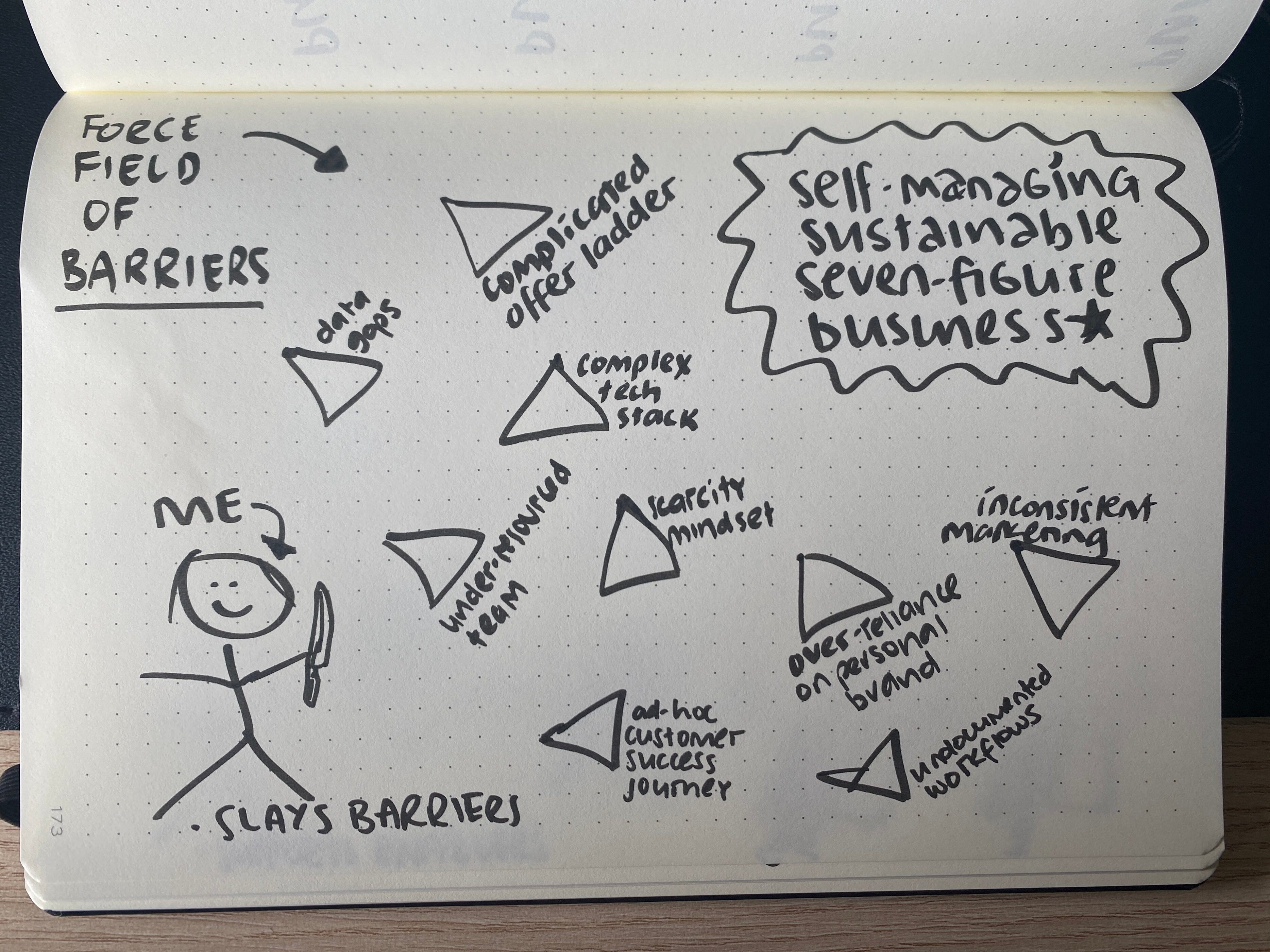
Here’s a diagram straight out my journal, where I gave this mental exercise a go.
I assumed my self-managing, sustainable business already exists – not as a possibility, but an inevitability. I considered that the only things standing in the way of me and the business is a forcefield of barriers. Here’s what it looked like:
Barriers Contain The Seed For Brilliance
This was a really helpful way for me to think about things. Not that I’m doing something wrong, or that the future is in question. Rather, that there are things standing in the way, which I need to remove.
Then, I asked myself the question: what if those barriers transformed into powerful enablers? What if each barrier contains the seed for brilliance? (a la, Ryan Holiday’s The Obstacle Is The Way.)
Instead of being pesky problems, those things become useful guides that light the path toward success. So, I drew that too:
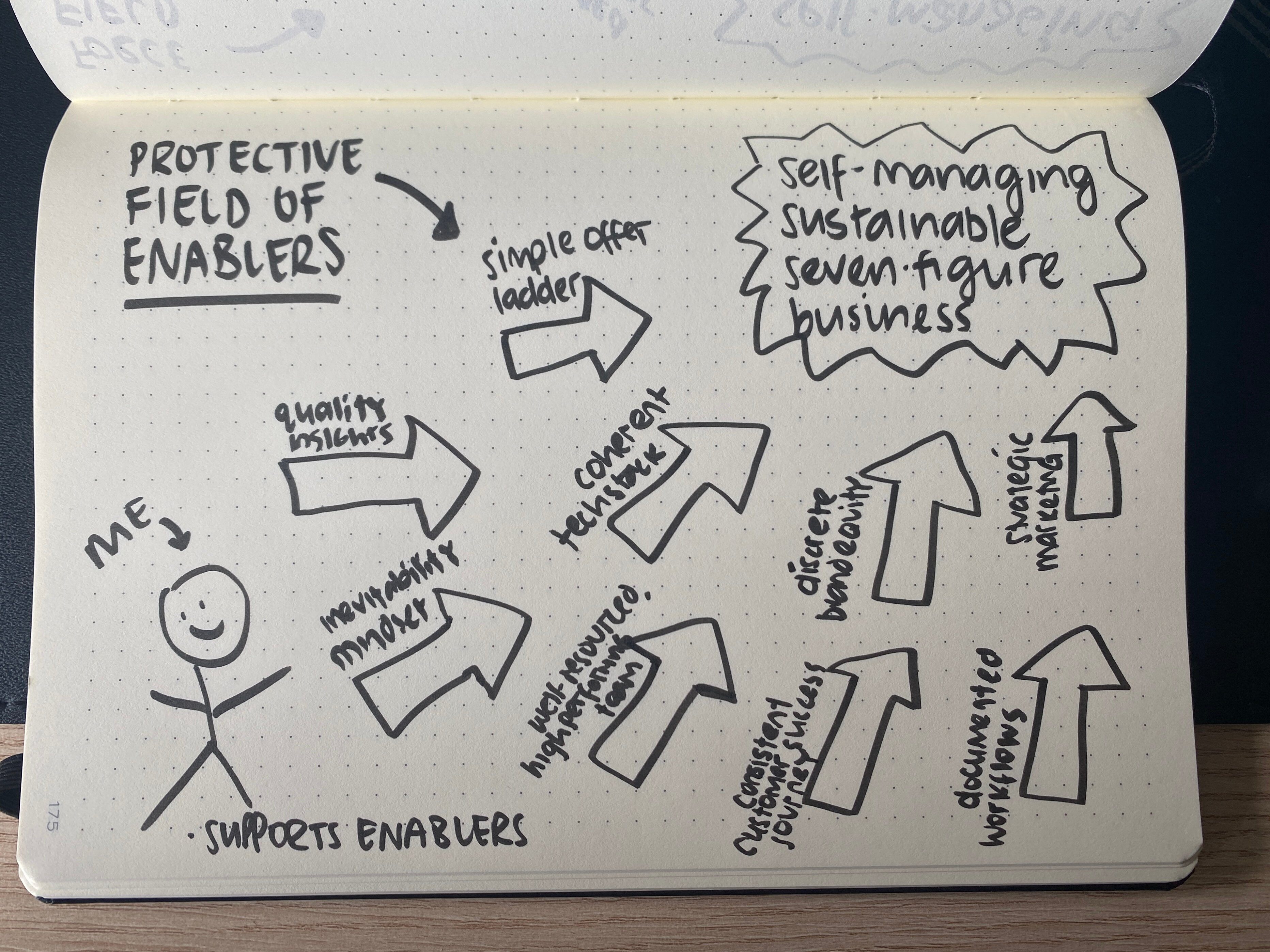
Suddenly, my barriers didn’t look so problematic anymore. They look like the seeds for brilliance.
If you can forgive my shoddy drawings (it’s my journal after all!), you might notice something important – the goal and I are not the same thing.
This is where my perspective differs from that of Dr. Hardy. I might be moving toward the identity of someone who has a sustainable, self-managing business, but I am not that. I’m still me.
The goal exists independently. I’m just one person, who has the opportunity to interact with those barriers and enablers in the way that I choose. If I succeed, fail, or otherwise, it doesn’t reflect on who I am as a person. I’m already cool. I’ve got what I need. I’m hanging out in the corner, with no hands, doing my thing. But I’m already OK.
In facilitation, we call this the third point of reference. The reason we use flip charts, whiteboards and Post-it notes in workshops is to help people tangibly differentiate themselves from their problems. It’s a physical message to everyone in the room that together we can hold, handle and solve our shared problems, rather than entangling ourselves amongst them.
That’s why getting your ideas down in front of you is helpful, even if your art is amateur like mine.
Your Challenge
Your challenge this week is to undergo a similar mental exercise.
Ask yourself: how would you behave if your goals were an inevitability? What would it look like to quietly remove barriers, rather than push for change?
Til next week,
A


