I went to grab some ice cream from the freezer last month and everything inside was melted. My fridge-freezer had internal temperatures over 20 degrees. Not ideal for our busy summer break!
A repair technician arrived a few days later, and his diagnosis was simple: the compressor took a shit and died. We needed a new fridge, he told us - and because the fridge was outside its warranty period, that was on us.
I disagreed. My fridge was less than five years old, and according to Consumer, we should expect at least 10 years out of a compressor. Haier, our fridge brand, appears to agree, now offering a 12-year compressor warranty on most new models.
I relayed this to the technician, but he was unconcerned. Not his problem. He was there to assess or fix the fridge, nothing more. After it was clear I wouldn't give up, he dug a business card from his wallet with a customer complaint email address on it.
Let the Terse Email Wars begin!
Read the full fridge anecdote here. Scroll past if you don't care for Bob from Haier.
First, I called Customer Service. The woman was friendly and helpful. Checking our file, she soon hit the first roadblock.
The technician had noted the compressor was busted, but had not explicitly labelled the fridge as unrepairable. She would need him to change that before we could go any further. I looked out the window and noticed the technician was still in our driveway. Huzzah! I raced outside to ask him to update his report.
He was cagey. "Technically," he began, "it is repairable. It's just that the part is too expensive, and we don't do it in New Zealand." I paused. "So... it isn't repairable then?" He demurred.
After further back and forth of this nature, I handed the phone over and he talked it out with the customer service rep. Eventually, presumably satisfied he wouldn't be held personally liable for my new fridge, he updated the report.
The customer service rep submitted my request, but warned it would take a while. One $70 Facebook Marketplace purchase later, we had a dodgy bar fridge perched on our bench, and it was time to wait.
The first email arrived five days later, from Bob.
---
Dear Alicia,
I have been asked to contact you with regard to your fridge.
Our technician has advised that based on the nature of the repair required and the age of it the best way forward will be to offer you a new one at a reduced price.
Accordingly, we are willing to supply you with a replacement taking into account the number of years of use you have received from your current model.
Your model is no longer available and the nearest model is a HRF580YHC4 which we would be able to offer for $380 including the GST content. It would of course carry a full manufacturer warranty
Your current Appliance will become the property of Fisher & Paykel Appliances and will be collected when your new Appliance is delivered.
This offer is open for 30 days from date of email.
We trust this proposal meets with your approval. To accept please respond to this email, with confirmation on your preferred method of payment, whether it be via credit card or bank deposit.
Should you wish to discuss this further, please do not hesitate to contact us or alternatively you can us our Chat function by clicking on this link.
We look forward to hearing from you.
Bob
---
Thanks, Bob. The language in this email is strikingly avoidant. "I have been asked to contact you with regard to your fridge" is not the "Sorry your fridge broke" we might have hoped for, but it was accurate (while a bit put-upon.) "Our technician has advised" is unlikely as the technician in my driveway avoided any kind of recommendation, much less a view on how to handle my warranty claim.
On the face of it, Bob's offer looked OK. Except I paid $3,000 for the fridge, less than five years before the compressor busted. Given most Haier fridges in New Zealand have a 12 year compressor warranty, and the suggested replacement fridge is retailing for $1,800, I found Bob's offer below par.
I went full Consumer Guarantees Act in my response. Bob left it a day, then came back in his usual charming, robot fashion.
Hi Alicia, thanks for your email. We are aware of the requirements of the Consumers Guarantee Act hence our offer of a replacement based 5 years of use.
This went on for a while. I refused the offer and asked for a new fridge, free of charge. They resisted.
Eventually, after three weeks, four terse emails, some generous quoting of the Consumer Guarantees Act and a refusal to back down, Haier agreed to replace my fridge at no cost.
Now, I'm not just telling you this so you can cheer me on for sticking it to the man. I'm interested in a few things about this whole debacle.
Mostly, that I was already primed and ready to argue.
Five years ago, I would have expected Haier/ Fisher and Paykel to offer apology and compensation. Their reputation was for good customer service. But in 2026, I set my bar much lower.
If you're a LinkedIn follower, you might remember my war with PB Tech last year. When I returned a faulty laptop, they held onto it while ghosting me for weeks, eventually telling me to stick it and take them to court. One social media post and three hours later, I had an apology call and the money arrived in my account. The comments section filled with similar stories.
I feel like I'm constantly having to advocate for my consumer rights these days. As a Kiwi I hate doing this. But when minimum viable service is the norm, my baseline assumption is now that I'll have to fight for what I'm owed.
This sucks on many levels.
In particular, it disproportionately affects people without the time, confidence and literacy to challenge unfair decisions or bad service. It's a compounding factor for our most vulnerable. As if it wasn't already expensive enough to be poor, let's add minimum viable service to the crap-stack! My 20-year-old daughter and her flatmates are being treated badly by their property managers right now, and I'm about to step in. Picking on tenants, especially uni students, is scum behaviour.
But I think this goes deeper than falling customer service standards. Further, even, than corporate enshittification.
In the first Wednesday Wisdom of 2026, I predicted the rise of three trends:
- Total bullshit - misinformation and disinformation will reach crisis levels, causing social and political disruption.
- Power transfer - public sector systems will scramble as tech companies monopolise social and economic infrastructure.
- Accountability loss - human responsibility will disappear and liability will be harder to pin.
I've been reading further about the accountability void this week in Dan Davies' book The Unaccountability Machine.
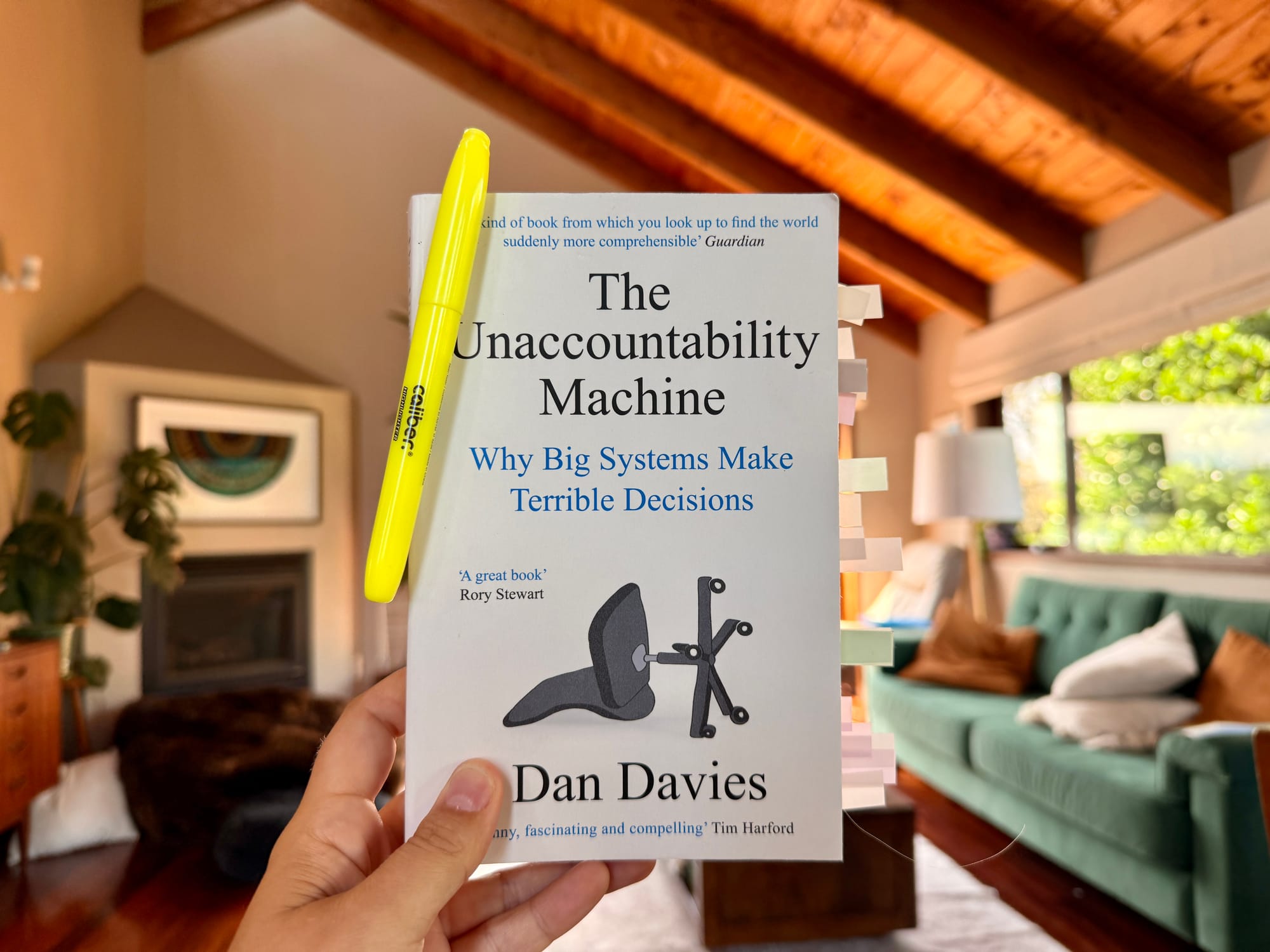
The book is part chaos, part revelation. Davies is a clever chook, with lots of sharp analysis (and a wildly thorough explanation of the now-defunct field of cybernetics, if you want to nerd out.) He offers a theory as to why companies and governments keep producing outcomes everyone claims not to want.
His thesis is that when modern organisations produce crappy outcomes, it's rarely because someone malicious made a bad call. It's hard to pin a decision on a person. It's more likely to be a chain of policies, buffers, systems and processes. There are reasons for that, some of which are good - fairness, consistency, efficiency, et al - but it can lead to a faceless machine spitting out garbage, and nobody to hold to account.
When you're bumped from a flight, Davies explains, you can't get mad at the customer service person who tells you, because you know they can't do anything about it. You can't call the CEO, because they'll know nothing about it. The responsibility lies in a muddy river somewhere between marketing, data and membership services. Nobody made the decision, yet a decision was made. He calls this buffering and diffusion an accountability sink.
The result is what Davies calls an unaccountability machine: a structure which produces outcomes without an accountable decision-maker.
This is my fridge quandary. It's the technician, operating within the letter of what he's doing, and being careful not to make claims with consequences. It's Bob, and his weird, passive language. It's everybody carefully applying processes and doing whatever they can to avoid being lumped with any liability.
Most frustrating is how benign the whole thing is. It'd be more satisfying if the conspiracy theorists were right and we could blame the Illuminati. I'd almost prefer if Bob from Haier was sitting in his lair stroking a cat and plotting to deny me a fridge than mindlessly generating templated emails.
This will get worse before it gets better.
Organisations are increasingly delegating their decisions to algorithms. Persuasive tech salesman are fear-mongering executives into ADOPTING AI BEFORE U GET LEFT BEH$ND, urging for staff to be replaced by software. Companies hide their phone numbers and email addresses so they can replace customer service representatives with chatbots.
Friction, formerly known as service, is disappearing in favour of click-through platforms without room for personal discretion.
Friction, formerly known as service, is disappearing in favour of click-through platforms without room for personal discretion.
To get anything else, we'll need to create our own friction. To become fluent in Terse Emails and Disappointed Phone Calls. To become skilled in holding the line. Quoting the legislation. Speaking to a manager. Pushing, pushing, pushing. With our time, confidence, and literacy, we can force the system to behave.
This is a crappy, unfair, non-solution that doesn't work at scale. Collectively, when we do this, we absorb accountability for these systems and organisations. Davies, for all his cleverness, had little to offer in the way of a solution to this (complex problems are like that.) I certainly don't have one.
So here’s my reluctant recommendation for 2026: keep your receipts, know your rights, and don’t be afraid of a well-aimed disappointed email.
Leave your own horror stories in the comments. Misery loves company.
Til next week,
AM
Free stuff for paid subs
Here's my accountability move. This week, Jenny emailed in. She'd hoped there'd be more regular or easily accessible tools and frameworks made available for paid subscribers. I looked at her email, checked out the site, and thought: yeah Jenny, you're right.
Because we're a small organisation with a simple feedback loop, I can take responsibility for this. I've grouped all the paid goodies here and, even better, I've made a $200 course available FREE for paid subscribers. Enjoy.
 Alicia McKay