


Last night, my family and I joined a long, snaking queue along Courtenay Place to see Dame Jacinda Ardern. Her Wellington appearance is the first of five events in New Zealand and Australia to promote her memoir A Different Kind of Power. The queue was the result of stringent, time-consuming security provisions: thorough bag searches, with no bags larger than an A4 page allowed inside, and a slow procession through guards waving metal detecting wands. I raised the cuffs of my jeans to show I had nothing strapped to my ankles before entering the venue.
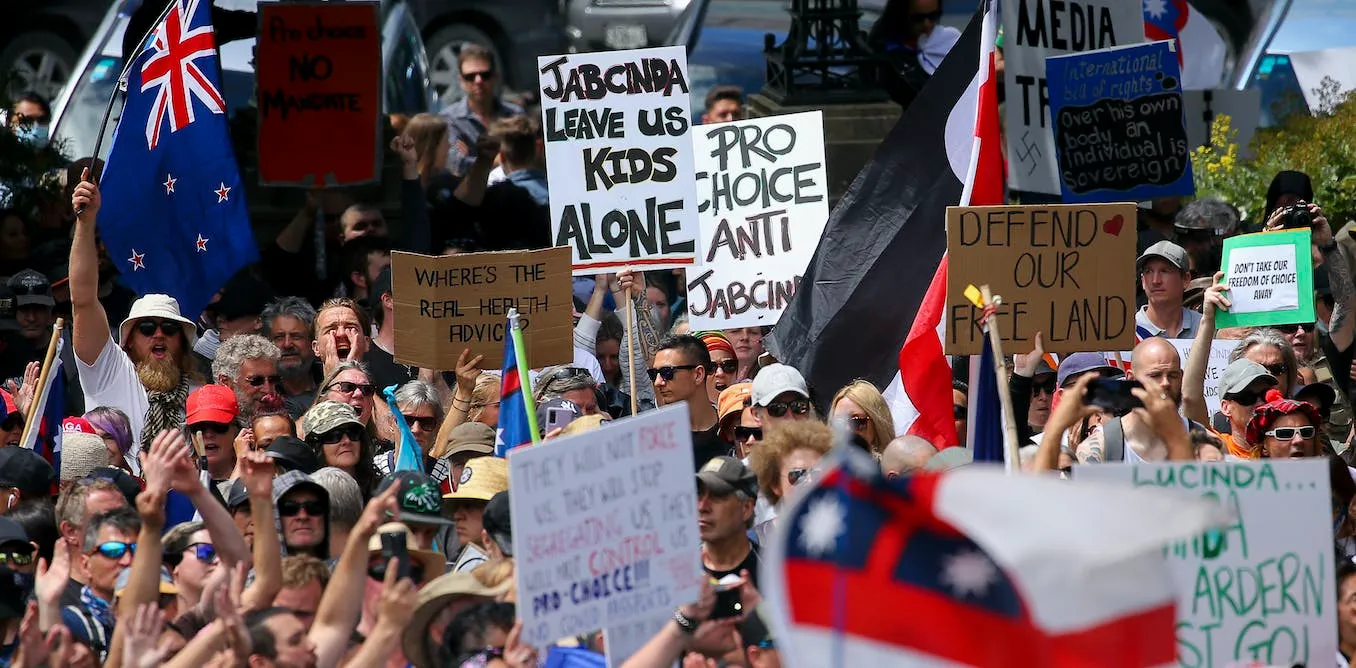
Decorating the queue were a smattering of protestors, holding signs recycled from a different time. While I respect the sustainability (I can imagine the phone tree now: 'Barry, have you got any old signs in the garage we can use?'), some of the slogans - Jacinda is out of control! - felt almost quaint.
Why people are still angry
On the face of it, protesting short-lived, long-gone vaccine mandates to a former Prime Minister shows admirable, if bemusing, commitment to a cause. We've had almost three years of a new government, but the rage persists.
But when we consider the deeper things at stake - loss of personal agency, technological overreach, war, job precarity, rents rising faster than wages, skyrocketing grocery bills - it becomes clear why Jacinda Ardern is an enduring target.
Few of these bigger problems have a clear person to blame, and the frustration has to go somewhere. We live in an accountability vacuum, so it makes sense that anger flows toward the most visible figures, if not the most powerful ones.
Where the anger comes from
The direction that anger takes is not accidental. It is shaped by the channels through which New Zealanders understand the world. The information ecosystems that sustain and amplify movements like Voices for Freedom are run by foreign-owned platforms.
According to DataReportal, YouTube (Google) reaches around 80% of the NZ population. Facebook has around 3.5 million users, and Instagram is used by 50% of the population. Both Facebook and Instagram are owned by Meta. Over two thirds of New Zealand's advertising spend is digital. The same two companies - Meta and Google - account for a majority share of that advertising globally. Our information sources are highly concentrated - and largely unaccountable.
Research from The Disinformation Project found that misinformation outperformed mainstream media content during the 2022 occupation of New Zealand's parliament - with just 12 people responsible for 75% of the content.
Anger gets imported from offshore
Ironically (or not), these information sources are extremely opaque - and often fuelled by foreign interference. Microsoft found that consumption of Russian-linked disinformation spiked in the months leading up to the occupation, with NZ consumption 30% higher than comparable countries.
Disinformation campaigns are routinely traced back to networks operating across borders, and they're hard for citizens, or even governments, to meaningfully scrutinise in real time. A Facebook group amplifies a misleading claim. That's then boosted by the algorithm, which optimises for engagement. It spreads across borders within hours. By the time it reaches Wellington, it feels local, urgent, and real - but its origins are effectively untraceable.
Join over 11,000 subscribers who enjoy thought-provoking essays, sharp insight and practical tools straight to their inbox.
Online misinformation has real-world impact
During the 2022 Parliament occupation, misinformation was foundational. Protesters, rejecting mainstream media in favour of alternative online networks, circulated claims that vaccines were part of a ‘depopulation agenda.’ This might seem extreme, but consuming misinformation is not a niche activity. A 2023 Netsafe report shows 91% of New Zealanders encounter misinformation at least monthly and nearly half of us experience it daily.
In times of great uncertainty, people look for explanations. When there are no simple explanations for that upheaval, motivated actors step in to fill the void.
Backlash to mainstream media and political institutions in the wake of the pandemic could be reduced to nutty conspiracy thinking - or, we could see it as a rational attempt to make sense of complex, interconnected systems that are otherwise hidden, unaccountable, and resistant to scrutiny.
Which would all be tolerable, if not for the real-world impact. When a few largely unregulated platforms, vulnerable to foreign interference and false information and fuelled by clicks, mediate the majority of information, chaos can ensue. And in the case of the frenzied 2022 occupation of Parliament, it did.
So, if not Jacinda Ardern, who is accountable for this state of affairs?
Power demands accountability
In a mediated, tech-dominated information landscape, there is a worryingly weak link between power and accountability. We're seeing some movement to close that gap - in the US, antitrust action against Meta is attempting to unwind its acquisitions of Instagram and WhatsApp, and dozens of US states have brought lawsuits over platform design. A jury in Los Angeles recently found Meta and YouTube guilty of designing products that knowingly harmed young people. Yet these interventions remain fragmented and reactive.
Spiderman told us that "with great power comes great responsibility" but responsibility alone is not enough. Responsibility may be moral but it is toothless. Accountability demands institutional and interpersonal systems that make power transparent and revisable. A leader can feel responsible, but change nothing. Accountability, in comparison, requires consequences, oversight, and the ability for others to intervene.
But accountability needs people
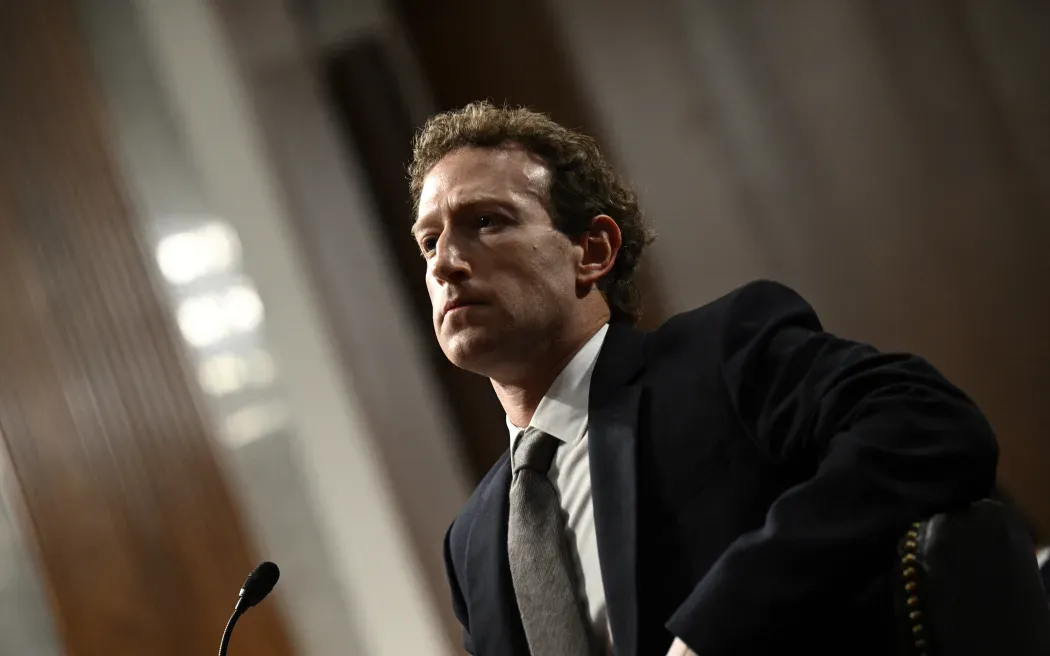
The difficulty with accountability is that it requires agents - that is to say: people. We need individuals we can scrutinise the decisions of, as well as mechanisms to rectify imbalances. The verdict against Meta and YouTube was possible because it is supported by a paper trail of senior executives acknowledging and electing to bury empirical evidence of their product's harmful impacts.
The very foundation of political legitimacy rests on this ability to hold power - and the people granted it - to account. When power migrates beyond these political and social accountability mechanisms, the legitimacy of the entire system erodes, even if the institutions remain.
Join over 11,000 subscribers who enjoy thought-provoking essays, sharp insight and practical tools straight to their inbox.
Accountability is the foundation of democracy
If people can't meaningfully influence the systems that actually shape their lives, the promise of democracy starts to ring hollow. We might still be able to vote and engage through the formal channels - but if it isn't keeping us safe, why would we bother?
It is difficult to overstate how critical accountability is to the legitimacy of our social and political fabric. We delegate our collective power and agree to rules that constrain our choices on the understanding that we can take it back, demand change, and vote for something different.
In the democratic contract, we expect transparency of decisions, proof of public good, and consequences for failure, in exchange for our trust and compliance. In exchange, we comply with the law, pay our taxes and fill in countless forms to prove our identity, protect our property rights and catalogue our existence.
Accountability systems protect us from evil
We do all these things because we've learned that faceless systems and unaccountable actors can do terrible things. In Eichmann in Jerusalem, an exposition of the reign of Nazi Germany, political theorist Hannah Arendt coined the term banality of evil to describe how harm emerges from systems where no individual feels responsible.
Few of the individual actors in Hitler's Germany, Arendt argued, were uniquely monstrous. Most were simply compliant. This is why we continue to rely on high-visibility political leaders and the grinding machinery of bureaucracy that support them. We understand that when accountability is too diffuse, when we can't pin it down, we are vulnerable to tragedy with no path to recourse.
But power is not just political, and it isn't just a top-down arrangement. Power is shifting away from visible, accountable leaders and institutions, into dispersed, invisible systems and platforms. As Michel Foucault observed, "power is everywhere… because it comes from everywhere."
Don't let the political theory fool you: these aren’t abstract philosophical concerns. They're embedded in the systems we rely on every day, systems which are concentrated, privatised, and inescapable.

Power lives in infrastructure
When you think infrastructure, you might think of roads, pipes, and buildings. But in a complex modern world, infrastructure includes the full range of physical and organisational structures we need for society to function. Social and economic infrastructure like markets, payment, communications, and information are crucial to keep things ticking over.
Infrastructure is powerful - in part, because it is so often taken for granted. When I work with Councils, we often talk about the frustrating paradox that people only seem to notice infrastructure when it breaks. The rest of the time it runs behind the scenes, powering communities and shaping our days and lives.
This has important implications for the ownership and control of our infrastructure. In the local government context, when human sewage flows into Wellington waterways, Councillors and public servants need to face up to the public and the media.
But what happens when there's no person to point to? When the system is the decision-maker?
Join over 11,000 subscribers who enjoy thought-provoking essays, sharp insight and practical tools straight to their inbox.
Public infrastructure is privatising
We live in the era of platforms. Platforms aren't just products sold to us by companies - or at least, not anymore. They're now core social infrastructure which, as Nick Srnicek argues in Platform Capitalism, increasingly set the terms for participation in economic and social life.
Core social infrastructure that was once publicly owned or heavily regulated is dominated by private, foreign-owned interests. Access to information is mediated by Google. Social communication runs through Meta. Payments are handled Visa and Mastercard. Core government and business infrastructure runs predominantly on Amazon Web Services or Microsoft Azure.
Much of New Zealand’s public and private internet backend runs on these overseas cloud providers. And when critical systems operate on infrastructure beyond direct democratic control, those private systems become a proxy for public infrastructure.
Mandatory services need accountability
Lack of democratic control becomes cause for concern when 'services' turn into infrastructure - and when opting out is no longer a realistic possibility.
Social and economic participation requires digital compliance. You can't easily 'opt out' of payment systems. You keep your phone nearby to check in for a flight, do your homework, or login to your banking. Avoiding cloud infrastructure is near impossible. Whether you need to access government services online, scan QR codes during a pandemic, or use two-factor authentication to manage your money, digital systems aren't optional conveniences anymore - they're the only way to get through the day.
At the same time, the state has silently receded from the picture. The post barely runs. The news is closing down. Public broadcasting is on its knees. Public health systems delegate the management of private patient data to private transcription services. We've let a handful of overseas companies set the conditions for social participation, with nary a regulatory body in sight.
The overreach of corporate power is not new. But the extent to which these companies have become mandatory intermediaries for participation in everyday life is. When vital infrastructure is privately controlled, our whole society depends comes to depend on private, foreign-owned interests - with no local accountability.
Oh, but it gets worse.
AI intensifies the accountability void
Platform infrastructure obscures accountability, but AI turns the dial up to 100 - accelerating decisions, while further dissolving responsibility.
AI models, and the companies that own them, are built and managed by humans. Every day, choices are made by individuals. But this responsibility becomes so diffused amongst a faceless mass of designers, data sources, deployers, and users, that accountability becomes impossible to locate and even harder to enforce.
AI widens the accountability void in three important ways:
- Distributed agency. No single actor controls the outcomes of an AI model - which is why they're so appealing to businesses looking to slash jobs. Decisions are made by an algorithm, so they can't be contested.
- Black box development. As per What the AI bros won't tell you, this is the tech equivalent of 'f**k around and find out.' Even the designers can't explain how their models reach certain outputs. We are governed by mystery systems whose logic is inaccessible to those they affect.
- Hidden deployment. All this decision-making plays out locally - on devices, in APIs, embedded in other products - even though it has far-reaching consequences. The decisions made by AI become invisible to the public sphere.
Together, these factors turn the accountability void into something of a black hole - what Dan Davies calls an accountability sink.
An automated system flags a welfare recipient for investigation. A credit algorithm denies a loan. A hiring tool filters out candidates. Decisions are made, but the reasoning behind them is inaccessible, and the appeal process is unclear.
Join over 11,000 subscribers who enjoy thought-provoking essays, sharp insight and practical tools straight to their inbox.
Regulating across borders is a nightmare
These multinational firms operate across jurisdictions. They book profits in low-tax environments like Ireland or Singapore, while gathering revenue from across the world. They engage in regulatory arbitrage, exploit every loophole they can find, and carry out well-funded, high-impact lobbying against the ones they can't. In this way they benefit from and embed themselves in public systems without ever being fully accountable to them.
There are a smattering of early attempts at regulation - the European Union’s AI Act, data protections under GDPR, bodies like Meta’s Oversight Board - but these are piecemeal, geographically limited, and lag far behind the pace of deployment.
Whether we're scared of looking anti-innovation, worried about falling behind, or simply impotent in the face of change, governments across the world, including in New Zealand, are doing little to stem the raging tide of technopoly.
State power is losing ground to technology
In a theoretical sense, states - and through them, us, the people - still hold formal power.
Technically, governments can enact regulation, demand taxation, and break up monopolies. But that practical capacity is constrained by the global, mobile nature of capital and digital infrastructure, creating a gaping chasm between theoretical power and actual control. Governments are reactive, responding blindly to systems they hardly understand, that are marching on at a pace they can't match.
The ongoing ability of people to influence government is no longer a given. Tristan Harris, former Google executive, founder of the Center for Human Technology and the documentarian behind The Social Dilemma and recently-released AI Doc, warns of a scenario where people lose political sway. If AI swallows enough jobs, Harris warns, the economic power base will make popular support all but irrelevant. The implications are unfathomable.
Apocalyptic predictions notwithstanding, it is clear that when economic power moves beyond democratic reach, political power tends to follow. One need only watch the Manosphere documentary by Louis Theroux to observe the pipeline from online influencer to political actor. Where the money goes, the power follows.
The consequences for political stability and social cohesion are obvious. When people feel powerless, as our dogged Jacinda protestors demonstrate, apathy eventually finds a path to anger.

We are focusing on the wrong target
These shifts converge into consistent, observable trends, which I outlined in January's 2026: The State of It report.
Power is now harder to see, harder to challenge, and harder to influence. Accountability has weakened, but the need for it has not. This results in misdirected anger, declining trust, and unstable politics. It's not that people are stupid, or don't understand the system, but more that the system itself has become unbalanced and illegible.
Most of the people in line at last night's Jacinda event ignored or scoffed at the protestors so earnestly brandishing their recycled signs. Some had pity in their eyes, others could hardly look. I get it. But I'm not sure they should be ignored.
It is true that Jacinda Ardern led a government that made consequential decisions affecting millions - and that democratic systems rely on leaders being held accountable for those choices. But the persistence and intensity of the focus on a long-gone PM suggests something deeper and harder to tackle: a very real mismatch between where power used to be, and where it is now.
Join over 11,000 subscribers who enjoy thought-provoking essays, sharp insight and practical tools straight to their inbox.
Snow melts from the edges
People are still directing personal and political anger at someone who no longer holds formal power because the systems which do hold power are hard to see, hard to name, and almost impossible to challenge.
At the height of the pandemic, Jacinda Ardern urged New Zealanders to rely on a ‘single source of truth’ - an appeal to trust, transparency, and accountable leadership. That model, an ode to a bygone era, assumes power is visible, centralised, and responsive to the public. But the systems that shape public and private life don't operate like that anymore. They are fragmented, opaque, and often beyond the reach of democratic oversight.
We should be careful dismissing these legacy protestors out of hand, because we're witnessing the whispers of something more than political dissatisfaction or garden variety misogyny. The vitriolic Facebook posts, review-bombing and sign-waving are the snow melting at the edges of an emerging legitimacy crisis.
Democracy is at risk from shifting power
The widening gap between formal power, social influence and tangible accountability is a symptom of a failing system. As Levitsky and Ziblatt argue in How Democracies Die, democratic systems don't often collapse overnight - instead, they erode gradually, as collective norms weaken and accountability breaks down. Just like the narrative voids being exploited by foreign disinformation networks and manosphere podcasters, this gap will be filled - and if history is anything to go by, it won't be filled by benevolent forces.
In 1840, Alexis de Tocqueville warned of ‘soft despotism’ - a system where control is not exercised through force, but through diffuse, unaccountable structures. When we delegate public infrastructure to private interests, allowing them to mediate our relationships, communication and payments, produce the stories that entertain us, exploit our attention, fuel our spending, and replace our jobs, we expose ourselves and our political future to exactly this phenomenon.
Let's change the target of our fury
If the protestors are anything to go by, we are still directing our expectations and our anger toward the leaders we can see, question, and vote out, rather than demanding more of the systems that invisibly shape our lives.
I'm not excusing political leaders, or claiming that governments and the people who elect them are powerless. But power has shifted and dispersed, and our accountability mechanisms are a long way from catching up.
Jacinda Ardern can be protested, criticised, and voted out. But an algorithm cannot.