In the Objective Era, we placed our faith in technocratic institutions and the progress they promised. Our faith in these systems has collapsed. We are entering the Subjective Era, defined by trust and meaning - and traditional leaders and organisations risk falling behind.
For decades, we worshipped the objective: science, reason, and truth. We placed our faith in technocratic institutions - government, academia, and the media - and were richly rewarded with advances in our collective knowledge and quality of life.
The rationalist worldview had its roots in the Enlightenment, but roared to life after World War II. Western societies built powerful bureaucratic states, media institutions, universities and scientific bodies, powered by data and research. We trusted the state, were reassured by journalistic integrity, and believed science and technology were the ticket to social progress.
But now, our trust in those things is faltering.
The sun is setting on The Objective Era. Welcome to The Subjective Era.
This isn't new, but it's picked up pace. Institutional credibility battles death by a thousand cuts. Inequality and concentration of wealth polarises communities. Political dysfunction, corruption and scandals rock trust in government.
The Internet and social media platforms changed the landscape. Unprecedented access to information and the collapse of global borders meant gatekeepers lost their stronghold on reality. Once everyone could publish with the push of a button, we started questioning what we were told.
Now, we drown in data. With AI creeping into news, education, workplaces, and pockets, information loses scarcity value. Facing shadowy figures and shifting facts, we're losing faith in the truth, and screaming out for meaning.
The crumbling reign of rationalism
Trust in government, media and progress has cratered across the developed world.
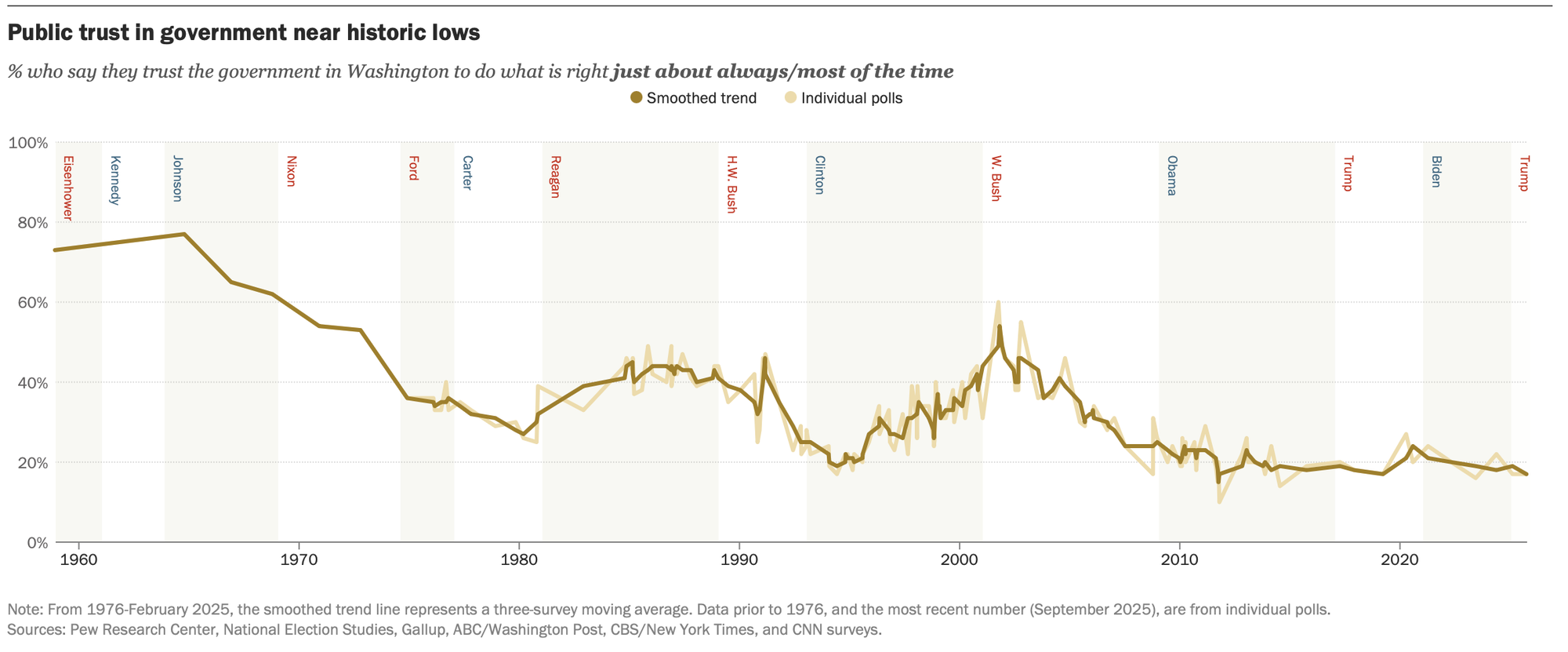
Political trust has plummeted
Pew Research measures public trust in US government from 1958. The Americanisation of media, culture, and technology platforms mean social and political changes in the US have downstream international effects.
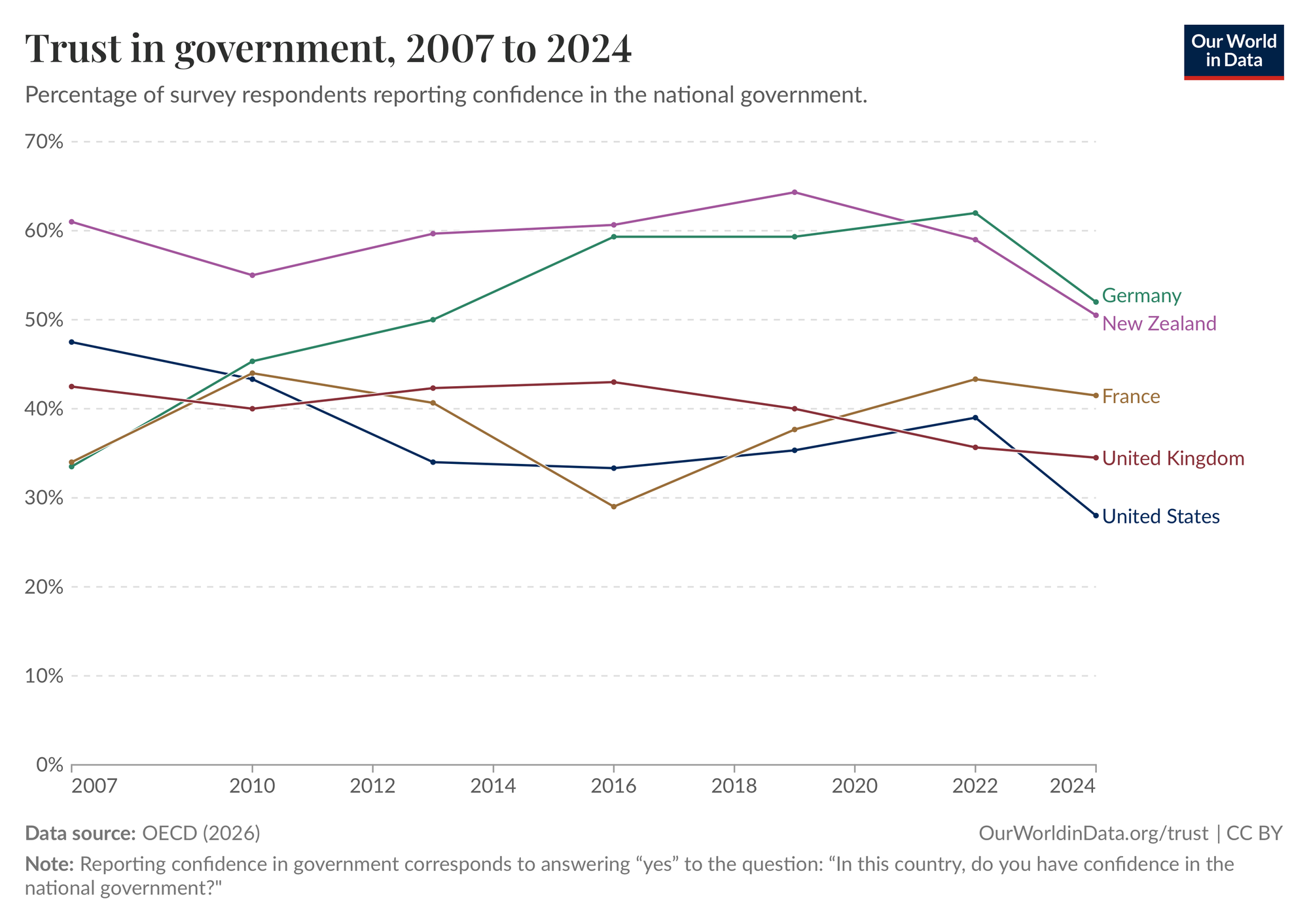
The OECD has comparative cross-national data on confidence in national government, but this only begins in 2007. An Our World in Data summary shows other countries demonstrate a less dramatic but aligned trend over the last 19 years. Falling trust in government matters because democracies ultimately rely on public belief and consent to function.
Media trust has tanked
Media trust has slipped over the same period, though New Zealand made international headlines this year for turning this curve. AUT's seventh Trust in News in Aotearoa New Zealand report, prepared in collaboration with Reuters, shows 37% of respondents now trust in the news generally, up from 32% last year.
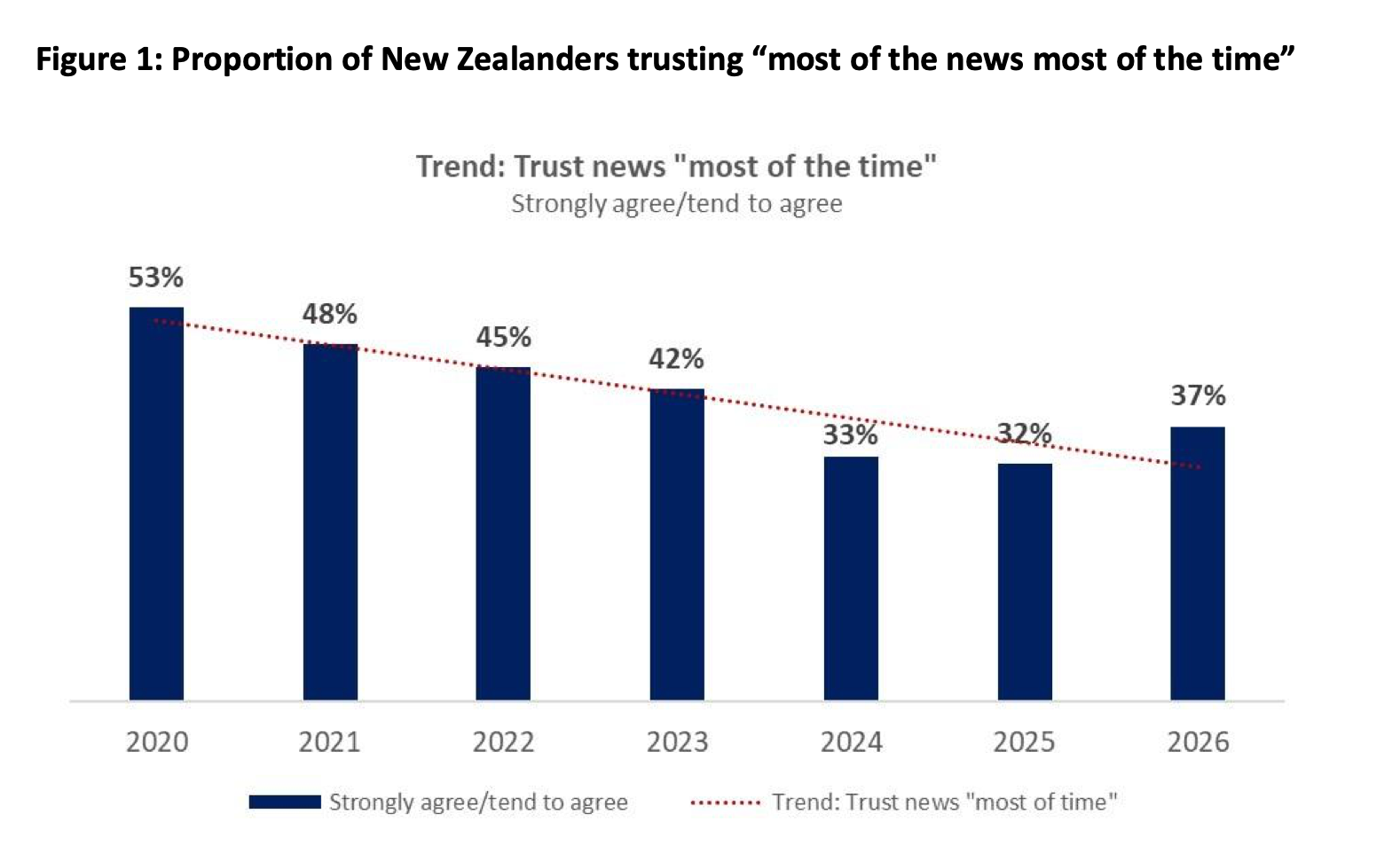
Not commonly mentioned in those headlines are the nuances:
- We still come in below the international average of 40%
- 78% of New Zealanders avoid the news
- 1 in 5 people use social media and video platforms for their primary news source.
- People describe ongoing discomfort with AI in news and information.
Media skepticism is warranted. Concentrating ownership and newsroom closures are signs of a weakening news ecosystem, access to which is increasingly mediated by a handful of foreign technology companies. As people get 'caught out' by AI-generated content, expect avoidance and cynicism to rise as it becomes more and more difficult to know what's real.
The UN and World Economic Forum warn that misinformation and disinformation - particularly that amplified by AI - are among the world’s most severe near-term risks.
We're pessimistic about progress
Mistrust in government and the media are not parallel phenomena. They're symptoms of a growing unease and disillusionment. Postwar liberal capitalism was built on the promise of endless progress - that things would keep getting better and the economy could grow forever.
The implied social contract - let us make the decisions, don't worry about the environment, wealth will trickle down - is wearing thin, as the breathtaking social and technological advancements of the last century are tainted by social, economic and environmental consequences.
Kate Raworth’s Doughnut Economics explores this tension in-depth. When economists categorised people, families, domestic labour and environmental degradation as “externalities” to economic growth, they were only ever telling part of the story.
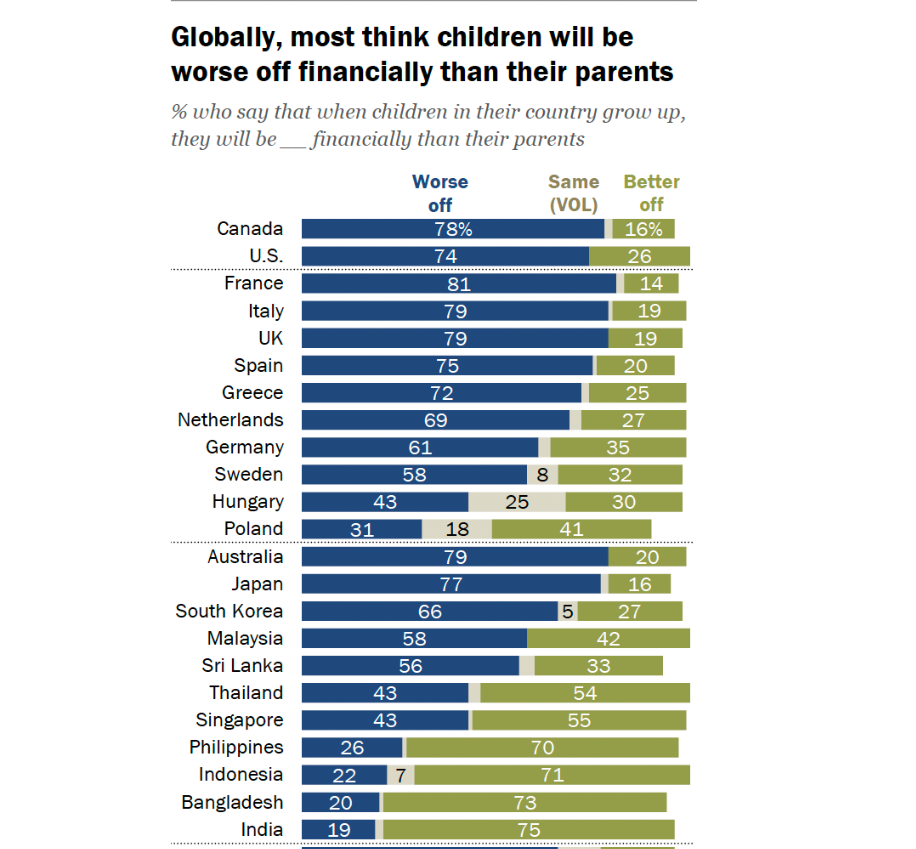
Across much of the developed world, people now believe children will be worse off than their parents. Loneliness and social isolation are rising. Young people report escalating anxiety, hopelessness and climate grief. Housing affordability has collapsed across advanced economies, while political polarisation and democratic dissatisfaction worsen.
Globally, there is widespread support for changing the economic system. In all but three nations surveyed by Pew Research in 2025, the majority of people say the economic system in their country needs major changes or complete reform. As our confidence in the future breaks down, trust in the institutions that promised it breaks down with it.
The rise of relational authority
The Edelman Trust Barometer has measured global trust since 2000. The 2026 report maps how our shared reality has eroded over the last 20 years, with trust shifting from authorities to peers.
As people have lost faith in government and the media, we've also become increasingly disconnected. Communities, social networks and friendships have weakened - but we still need trusted figures to interpret reality.
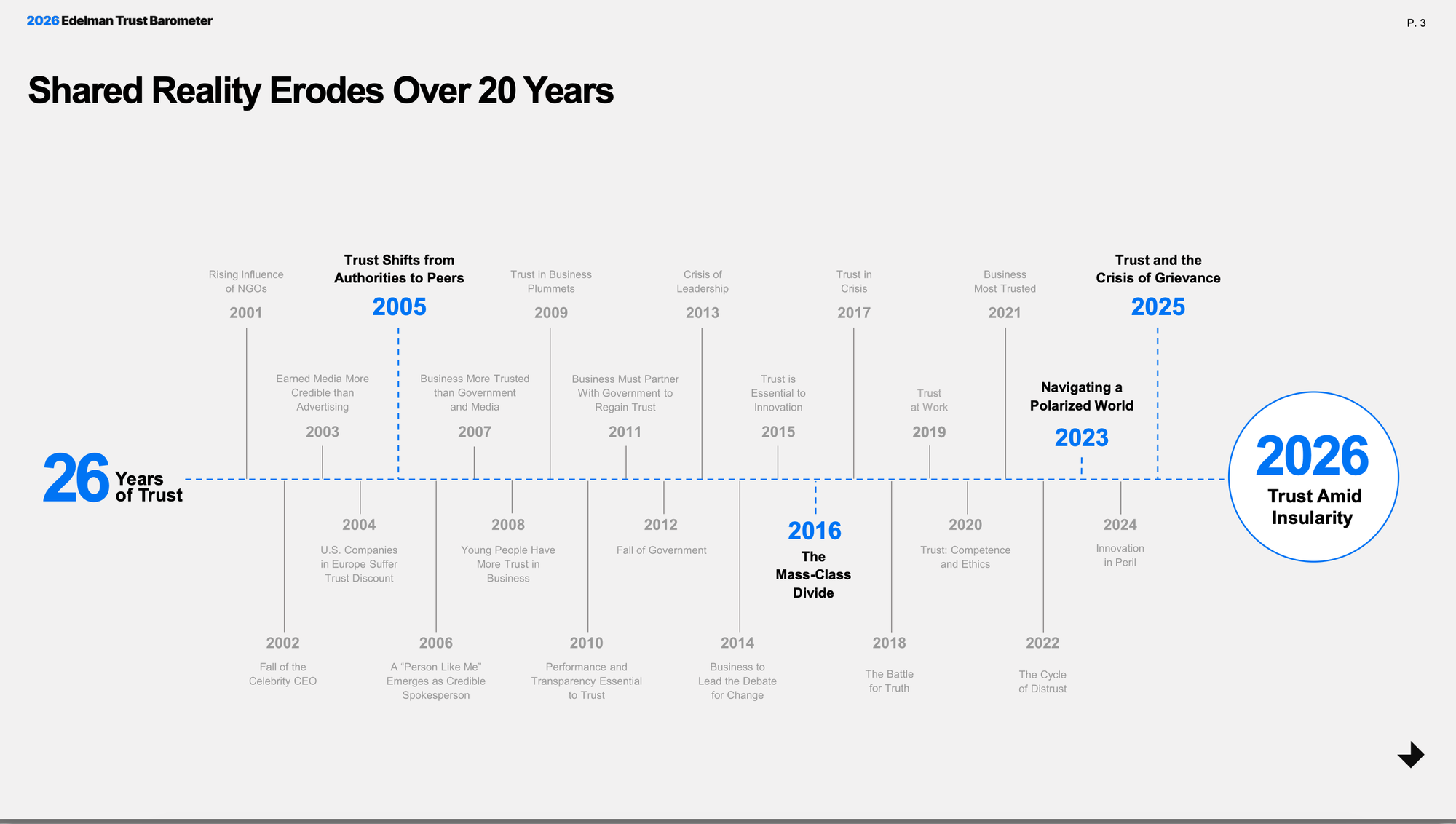
While some in media, business, and government have struggled to adjust to shifting trust dynamics, others have thrived.
Podcasters and YouTubers have ridden a wave of extraordinary influence. The world's most powerful companies now trade on meaning, not making. States like Korea, China, and Japan have mobilised effective soft power strategies. Formerly fringe groups have exploited division to establish think tanks, media channels, even alternative currencies.
Parasocial trust benefits creators
Joe Rogan - with 14.5 million Spotify followers and 20 million YouTube followers - has a bigger audience than the Washington Post, Wall Street Journal and New York Times.
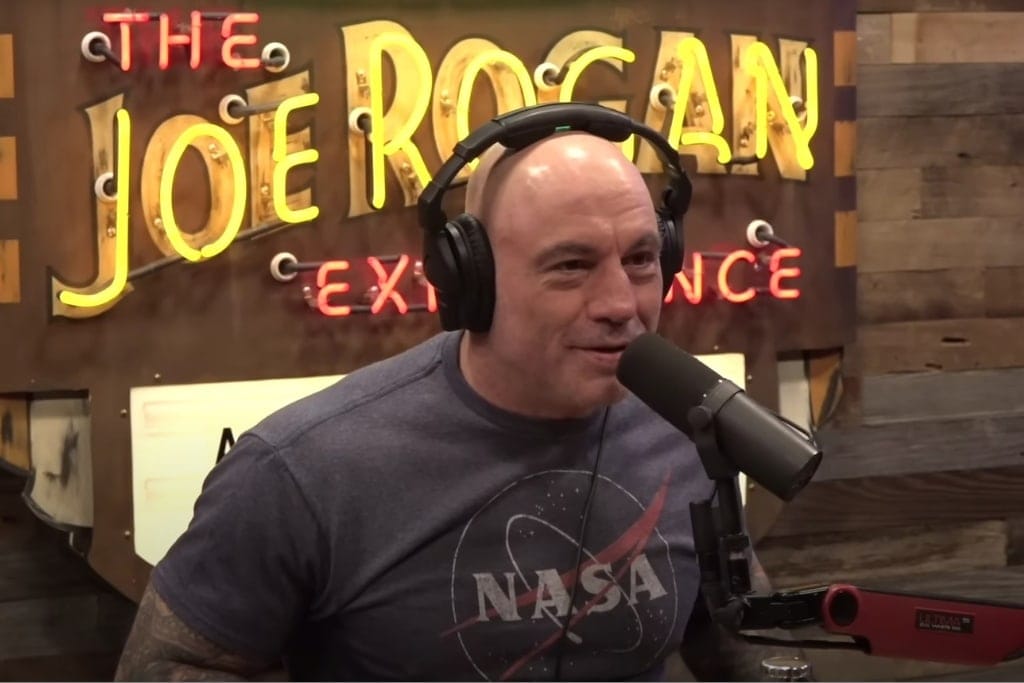
His authority doesn't come from expert credibility or editorial process. People trust Joe Rogan not in spite of his lack of traditional authority, but because of it.
Academia, too, has battled this gap for decades. The world’s best thinking is written by clever experts, in obscure language, then hidden in paywalled journals. Expertise is incomprehensible to ordinary people, and the public has switched loyalty to more accessible formats, regardless of their reliability.
Joe Rogan is the apex of a booming industry based on intimate, long-form conversations that command huge audiences. The information landscape has shifted authority from journalists and experts to CEOs, podcasters - and charismatic academics like Brent Brown, Adam Grant and Andrew Huberman, who package evidence for commercial success.
AI will only accelerate this shift. Words and images - things that used to be laden with context, process, and thought - are now junk products spat out of a machine. Under these conditions, people pivot to meaning-making that feels more real. Emotional connection, intimacy and community. The more synthetic and shallow our information environment, the more we look for human signals and trusted translators.
Meaning drives the economy
Weakening institutional legitimacy isn't confined to politics and media. The economy shows this shift to subjectivity.
In the industrial boom of the 20th century, the world's biggest companies made things. Companies like General Electric, ExxonMobil and IBM reigned supreme. Now, the highest-value firms trade in identity and attention. In 2026, seven technology companies - 'The Magnificent Seven' - comprise over a third of the US sharemarket.
In 1975, intangible assets (brand equity, intellectual property, et al) represented roughly 17% of S&P 500 company value. Today they account for 92%. Ocean Tomo describe this staggering transformation as an economic inversion, where "economic worth has migrated from what can be touched to what can be thought."
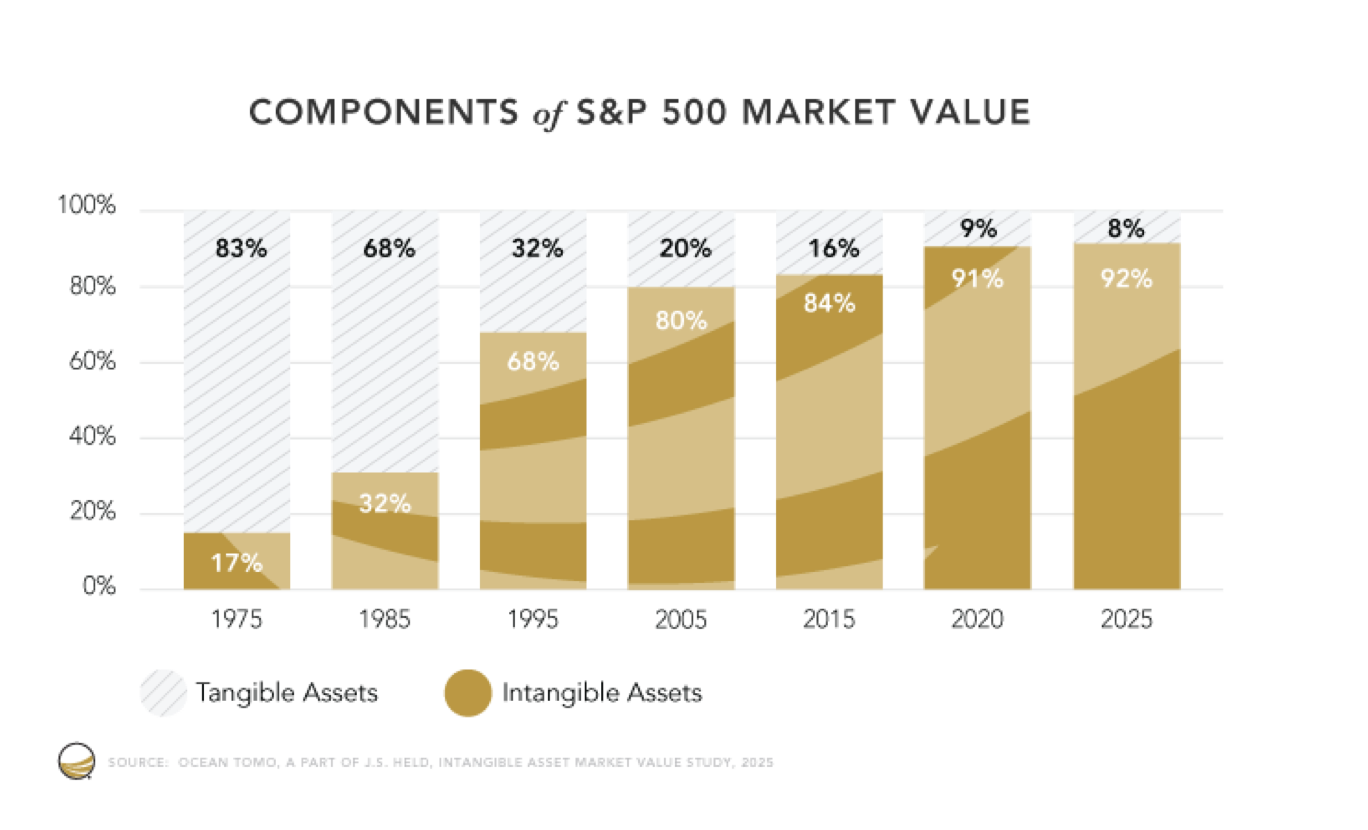
Tangibly, we see this transition in the rise of brand culture. Nike shoes aren't popular because of superior rubber. Chanel bags aren't a status symbol because of quality leather. These brands are valuable because of the meaning we attach to them: status, identity, aspiration, and belonging.
Countries covet cultural power
The economic shift from making to meaning isn't just for companies. Switched on nations have been preparing for this shift for decades. As I wrote in this article, South Korea is perhaps the best example of soft power as economic strategy.
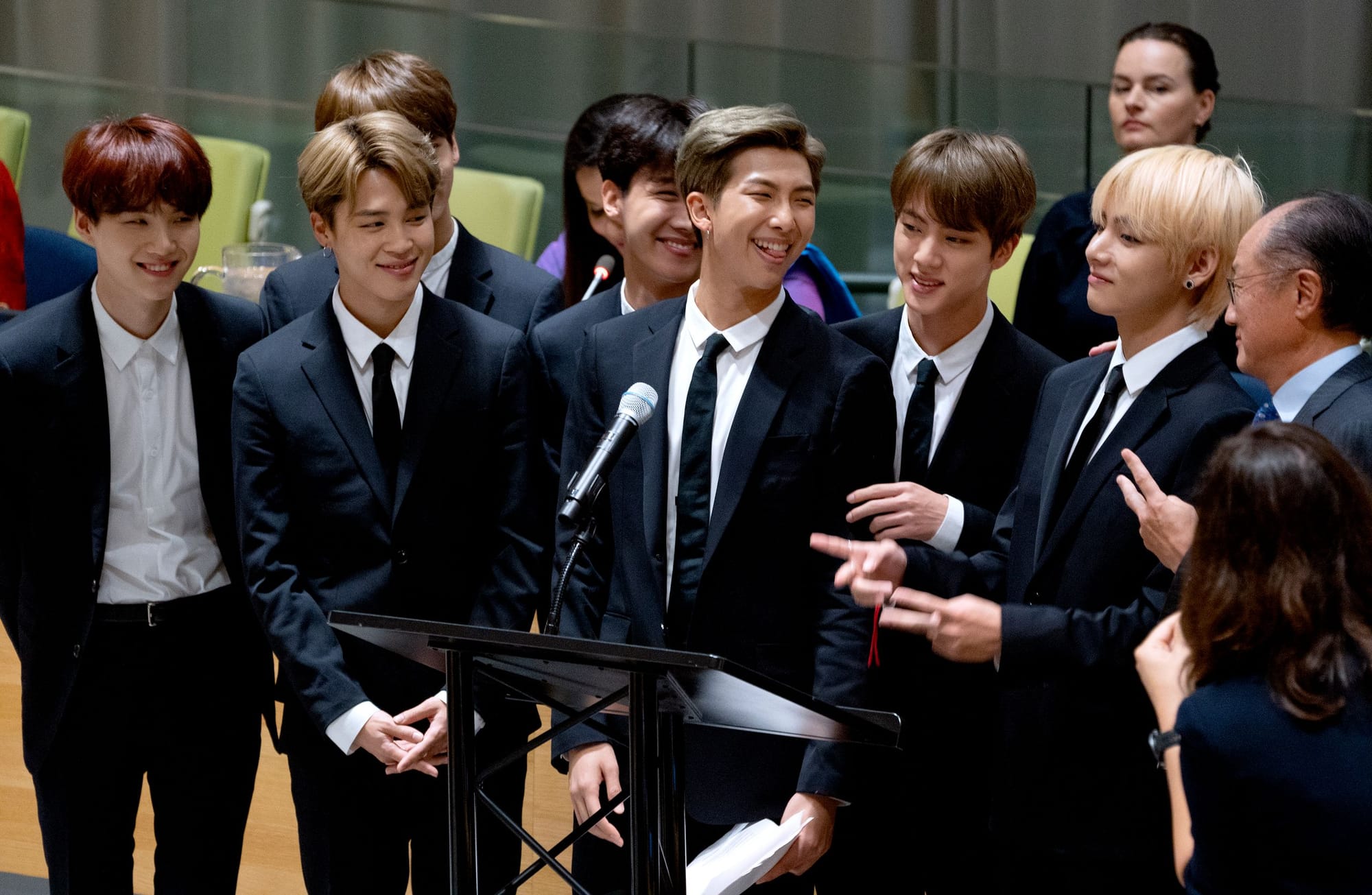
This didn't happen by accident. The Korean government made an intentional shift after the 1997 Asian financial crisis, investing heavily in entertainment industries, funding creative infrastructure, and supporting global distribution. Now BTS is at the UN.
Japan's "Cool Japan" strategy invests in anime, manga, gaming, design, food and fashion. The UK has the long-running British Council. Ireland's record investment in arts and culture has been explicitly tagged to increasing the country's global impact.
These states understand their most valuable exports are now culture, art, and thinking, not widgets and primary production. The numbers back them up. The global creative economy is one of the fastest-growing sectors, with 2021 was declared the UN's International Year of Creative Economy. As UNESCO declared: "Creativity is the industry of tomorrow."
Whether you're a country or a company, the new economic model doubles down on trust and meaning. Intangible assets like attention, meaning, and culture are fundamentally trust-dependent. A factory can operate regardless of public sentiment, but a brand, platform, media ecosystem or cultural institution can't. When people stopped trusting Twitter/ X, advertisers and users fled. When Ellen Degeneres's "kindness" brand was shattered by revelations about a toxic workplace, her ratings fell, her reputation cratered, and the show ended.
In this environment, trust becomes the scarce resource.
The dark side of subjectivity
Which sounds sort of lovely, doesn't it? But there’s a dark side to this departure from reason.
In Doppelganger, Naomi Klein describes the rise of what she calls the “Mirror World” - fractured online realities that take legitimate grievances and direct them in conspiratorial and anti-democratic directions.
Conspiracy theorists hijack people's anger at inequality and corporate greed to promote antisemitism and a fear of a New World Order. Wellness influencers pivot from organic diets into anti-vaccine rhetoric. Right-wing figures like Steve Bannon co-opt working class language and fears into moral panics targeting marginalised groups.
When institutional trust weakens, people still look for coherence, belonging and moral certainty. In fragmented information environments like ours, identity narratives fill the vacuum.
History warns of the danger of identity rule. We've seen what happens when authoritarian figureheads weaponise grievance. In the aftermath of World War II, liberal democracies built institutions explicitly designed to prevent the return of fascism, ethnic nationalism and authoritarian myth-making. The postwar democratic order promised us: “never again.” Yet here we are, again.
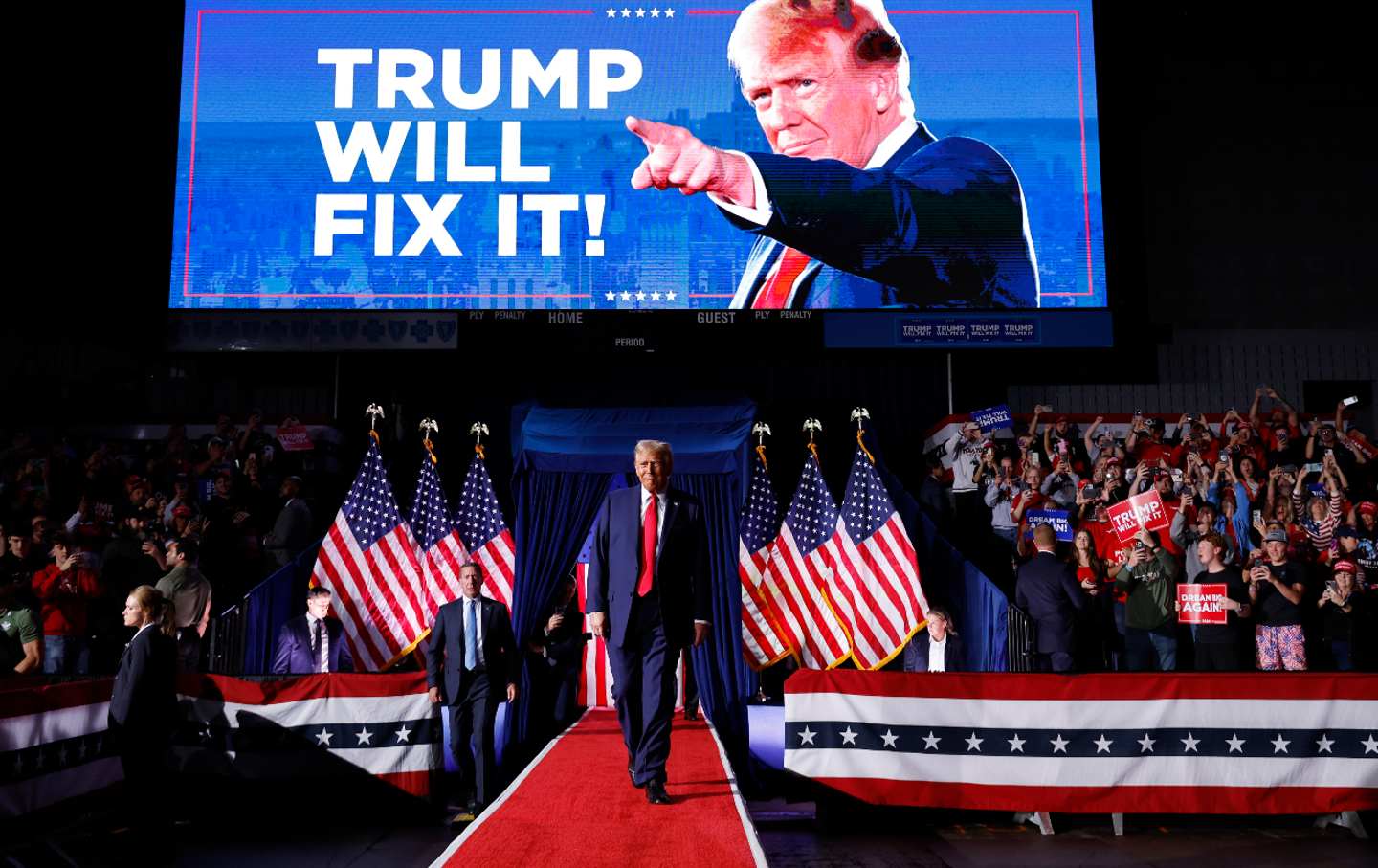
The last decade has seen a resurgence of politics we thought we'd seen the back of - Brexit, Trumpism, rising authoritarian nationalism, conspiratorial movements and democratic backsliding.
There will always be actors who benefit from distrust and decay. The more unstable and alienated people are, the easier we are to mobilise through fear, identity and resentment - but at what cost?
Life without shared reality
People are exhausted by objectivity and abstraction. We’re skeptical of science. We’re untrusting of the media. We roll our eyes at the politicians. Who cares about GDP when people can’t afford groceries or rent? Impersonal statistics don’t reassure or unite us, not like stories and connection to lived experience.
Humans aren't purely rational animals and the facts never spoke for themselves. They’ve always needed trusted interpretation for cut-through and we’ve always been subjective, emotional creatures with biased, blinkered lenses. Social media, AI, and populism didn’t make us tribal or emotional, they just exploited it.
Despite this, truth still matters. We can't afford to give up the technocracy entirely. Experts can be biased, but vaccines need scientists. Bridges need engineers.
Businesses can be extractive, but people need jobs and economies need connecting. Politicians and public leaders can be myopic and risk-averse, but strong, trusted government is the foundation that makes everything else possible.
Unless leaders in traditional institutions switch gears, they'll continue to lose currency. We've lost our way, and started optimising for the wrong things. Academics write for their peers, the media publish for clicks and outrage, and politicians announce policy for the polls. But who is optimising for the public good? Who is turning complexity into meaning? Who is reaching into the hearts and minds of the cynical masses? Right now, it's platforms, populism, and podcasts.
We have underestimated the importance and power of emotional legitimacy and trust. Rising populist and parasocial authorities have leveraged that failure. Their followers wear hats and tshirts and vote in ways that baffled liberals write off as ignorant or aberrant. This is a mistake. Instead of condescending to these movements, we should learn from them.
The reign of the technocrat is ending. The challenge for leaders in the Subjective Era is to learn how to build trust, translate and connect across fractures and divisions. The future health of our democracy may hinge on how quickly institutions and leaders get new skills, structures, and strategies - and if they can do it faster than bad actors can exploit their absence.
What next
In Part 2: How to Lead in the Subjective Era, I dig into skills to develop and structural shifts we can make.
 Alicia McKay