
 Think for yourself
 See more clearly
 Make better decisions
 Live on your own terms
 Speaking
 Training


People are so annoying. With their needs, their demands, their faces, and all their wrongness. And that's just at home. At work, they send emails too. We didn't choose those people. We don't love them. It's no way to live.
On our more enlightened days, we step back and see things for what they are: dozens, even hundreds of capable, well-intentioned people fighting the same existential dread. But little about our psychology or organisational design encourages this perspective. Instead, we default to treating systems failures as people problems.
(Here's a short video I posted on LinkedIn this week about the risk of blaming people. If you're short on time, watch that and rock on. If it lands, a like or share helps it travel.)
Why we struggle to think in systems
Our brains don't work like that
Most of us aren't predisposed to be systems thinkers. We're wired for linear, cause-and-effect thinking. We like a story with a clear beginning, middle, and end, and we're riddled with bias, fear and identity hang-ups. (No, just me?)
In scary and uncertain times, we're stuck in our limbic brain worrying about the future. Ongoing restructures, short political cycles, economic downturn, or the threat of job loss to AI put us in survival mode, which eats the capacity for more considered thinking.
In environments like this, soundbites and reductive (read: blamey) takes gather momentum, because it's easier to digest those than the unresolved events, wicked problems or contradictions the world is really made of. In uncertain times, we point fingers at people, not systems.
 Alicia McKay
Systems are sneaky
Systems are more complex than our default ways of thinking.
- They're non-linear. Systems behave in counter-intuitive ways, which means small actions can have big consequences, and big changes can do nothing. Meanwhile, there's lots of little connections and interactions under the surface which can compound and spit out unpredictable outcomes.
- They're non-temporal. There can be big delays and complex pathways between cause and effect, none of which gels with short-term performance targets, political cycles, ROI calculations - or our general impatience.
- They're non-visible. Many systems are made of hidden and abstract relationships, not just physical parts, which makes them hard to keep track of. Unlike behaviours and outcomes, which are easily spotted, the workings of a system can be sneaky and hard to pin down.
We organise ourselves into silos
At school and work, we learn to understand things by breaking them into manageable chunks. We prefer analysis to synthesis, because it feels neater and more controlled.
The McKinsey method, a consulting paradigm that chunks problems into individual, optimisable pieces, is reflected in the way we organise government (individual ministries, clear divisions between operations and policy), teams (functional silos and project teams) and projects.
Without the chance to see how everything fits together, we can overestimate the impact of our own work. This makes us myopic and increases the risk of "best practice" improvements that fall flat or make other people's lives harder.
Subscribe for weekly insights on systems, power, and strategy.
We reward compliance and certainty
We reward efficiency, compliance, and procedural risk-mitigation over slow thinking and exploration. Resistance is possible, but it's energy-intensive at best, and explicitly punished at worst.
We don't like going into things without knowing what we'll get out the other side. Our minds prime us for this with the availability error, or what Daniel Kahneman calls "What You See Is All There Is". We overemphasise the significance of what we already know and use that to draw conclusions. Centuries after the invention of the scientific method, we still aren't very good at disproving our assumptions and ideas.
We design processes that cater to those biases. Business cases, grant funding, research proposals, annual plans, role definitions and project scopes need to be specific, sometimes to the dollar and day, about what will be achieved. We don't know what we don't know, and finding out needs discovery and iteration. There are few organisational pathways that cater to that and even if there were, there is little time, space, budget, trust or flexibility to meaningfully engage in them.
The consequences of not thinking in systems
When you roll all of this together - our wiring, our workplaces, our environment - the consequences are predictable.
- We fix symptoms, not causes. Locked in a cycle of reactive fire-fighting, underlying structures are left intact and patterns persist.
- We make things worse. A failure to predict second-order effects and appreciate relationships and connections means we generate unintended consequences that leave things worse than we found them.
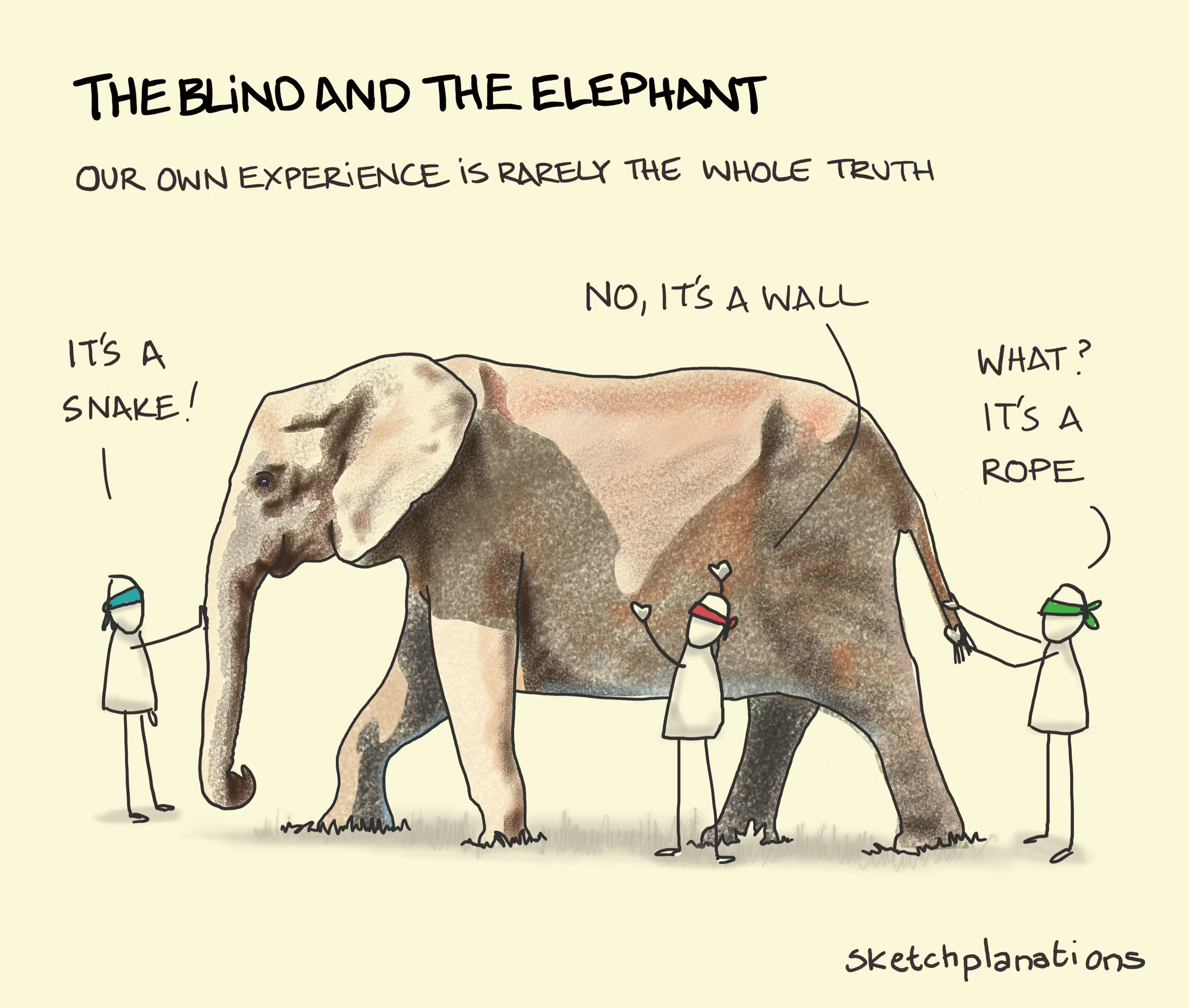
- We waste time and money. In any organisation, you'll find siloed change programmes running in tandem, all attempting to fix their own part of the elephant. When none of these do the job or shift the needle, those resources go down the drain.
- We miss the point. Achieving individual KPIs, delivering localised projects on time, mitigating risk, and flying under the radar are all perfectly reasonable goals - but are unlikely to deliver the outcomes we built the machine for in the first place.
Systems thinking is a critical skill
Despite all these barriers, becoming a systems thinker has never been more important. The problems we're trying to solve and the environments we're operating in are more complex than ever.
When we think in wholes, not parts, we make better use of our limited time, energy and resources, spot key leverage points to intervene in, and improve relationships rather than just optimising one part of a business to the detriment of another.
Systems thinking helps us to dissolve our problems, solving issues at the source rather than treating symptoms or pushing the problems somewhere else in the chain. And when we see things from all the angles, our strategic planning and future readiness improves too. We're better able to anticipate secondary effects and systemic shifts, and we adapt better to changing environments.
Subscribe for weekly insights on systems, power, and strategy.
How to shift into systems thinking
I spot the same patterns in every organisation and industry. The lowest form of problem-solving targets the most visible issue: people. We protest, point fingers, and performance manage our way through. If only people were better, clients tell me, we'd get better results! So they get a new CEO, vote in a new government, or restructure the team - only to see the same patterns persist.
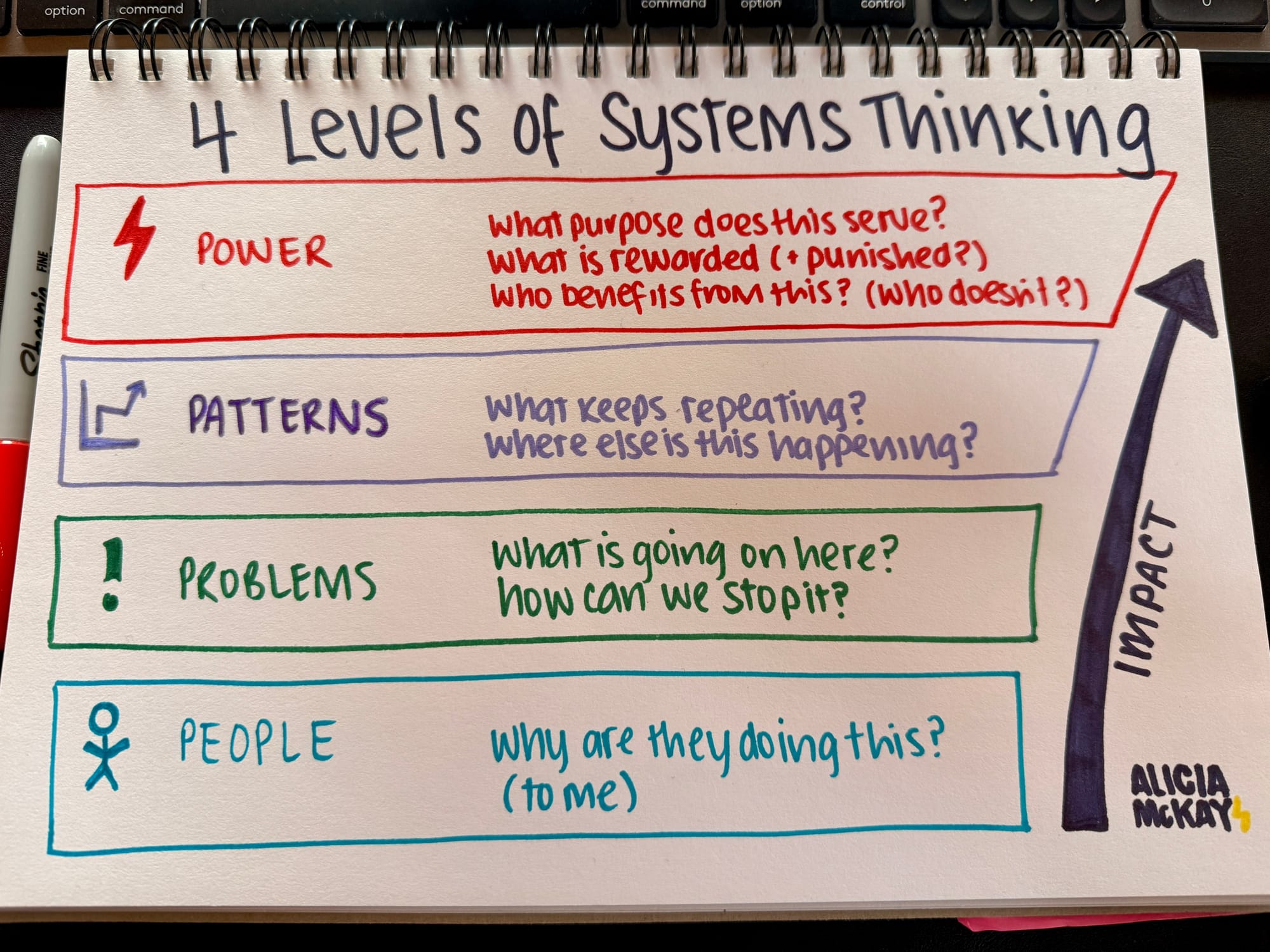
Systems thinkers zoom out and move up the chain to see the bigger picture. Here are three levels of systems thinking to bring more perspective to your trickiest challenges.
Move from people to problems
If we put down the pointy stick for a minute, we can look at our problems as their own distinct units of analysis. We can cup the problem in our palm and stand around looking at it together: hmm, looks like we've got a communication bottleneck here, or a workflow breakdown. How can we solve it? Once you separate ideas from identities, you're more likely to find solutions that people participate in - and every time you target a solution at a connection point, rather than a single part, the system improves for all the affected parties.
Move from problems to patterns
The problem is almost never the problem. More likely, it's a symptom of something else, something that shows up in different forms, contexts, and people. This is where our isolated communication bottleneck might reveal itself as a policy issue or lack of clarity about roles and team functions. Finding patterns means playing detective: asking around, looking at trends, or asking questions about how things have happened in the past. When you find a pattern, you are more likely to dissolve a problem at its root by changing the settings in the environment that causes it.
Move from patterns to power
Most problems can be tackled at the pattern level - but the trickiest ones involve power dynamics. If we consistently generate the same unhelpful patterns even after we've fixed the settings of the system - rules have been changed, resources have been allocated, relationships have been improved - then these outcomes aren't an accident. They serve a function and the system is working as intended.
When you hit a pattern that won’t shift, it's time to ask different questions:
- Who benefits from this continuing as it is? (And who doesn't?)
- Who would lose out if this got fixed?
- What behaviours do we actually reward? How? Why?
- Who has the authority to change this - and what’s stopping them?
These questions help us understand the forces shaping behaviour and often require changes at the highest point of the system, or with external stakeholders. This is the hardest level to effect change, but often the most transformative.
Practical steps you can take today
You don't need to zoom all the way up the ladder or change everything overnight. In fact, systems change works best when we start small and observe closely. Systems are dynamic, non-linear, and tend to have lag time before second-order effects emerge. Change one thing, and watch what happens over time.
But if you want to start applying systems thinking more consistently, here's a few useful hacks to remember:
- Pause more often. Your first reaction can be biased, egocentric, or reductive, especially under stress and pressure. Building the pause muscle - stepping back, adopting some compassionate curiosity, and asking more questions before jumping in or reacting - almost always leads to better results.
- Focus on relationships, not things. Never look at a part in isolation. Always ask how the parts interact. When you're tempted to blame people, zoom out to understand workflows and connection points between people, teams and processes. Improving a relationship is a positive change for at least two parts of a system.
- Interrogate second-order effects. Before solving a problem or launching a new initiative, consider what and who else will be affected by the change. You likely have a reference class for this: what has happened with changes like this in the past? What other initiatives are happening at the same time? How will the cumulative load affect users and stakeholders? What might the consequences of your idea be in 1, 3 or 5 years time?
- Look for loops. Upgrade your default view from cause-and-effect, to cycles-and-patterns. What usually happens before and after this? How do these events reinforce one another? Where might you intervene? Drawing messy maps can be helpful here.
- Leave your desk. Don't be fooled by the unread emails and pinging DMs. Few important challenges can be solved in your own head, and many of the assumptions you're making about how other people and teams work is wrong. Pick up the phone, go talk to people in their environment, or go on a site visit. You'll be surprised how quickly your frame of reference changes.
It’s easy to blame people - anyone can do it. Many leaders never get past this kind of thinking - and I get why. Problems almost always present as people and their behaviour. Systems don't come knocking on your door, or set unreasonable deadlines, or let you down when you're waiting on an important piece of information.
But there's a ceiling to this kind of problem-solving, and it can trap us in a loop of reactivity while never really improving things or delivering the outcomes we're there for. Move from people → problems → patterns → power, and you're more likely to leave things better than you found them.
Til next week,
AM