
 Think for yourself
 See more clearly
 Make better decisions
 Live on your own terms
 Speaking
 Training


Make a cuppa, get your notebook out, and put your thinking cap on! In Part 2 of the Subjective Era, we're getting stuck into the leadership skills and structural shifts you'll need to make a difference in this crazy new world of ours.
The old leadership model is dying
In the Objective Era, our ideal leaders were rational, technical, and managerial. We designed education and career pathways for this: do a degree, know lots of stuff, take on increasing responsibility to match your increasing knowledge, dot dot dot, become the boss. When we place our faith in truth and science, believe in progress, and trust that institutions have our best interests at heart, this works... kind of.
 Alicia McKay
Except this model never reflected reality. The people who make a difference are rarely blinkered boffins.
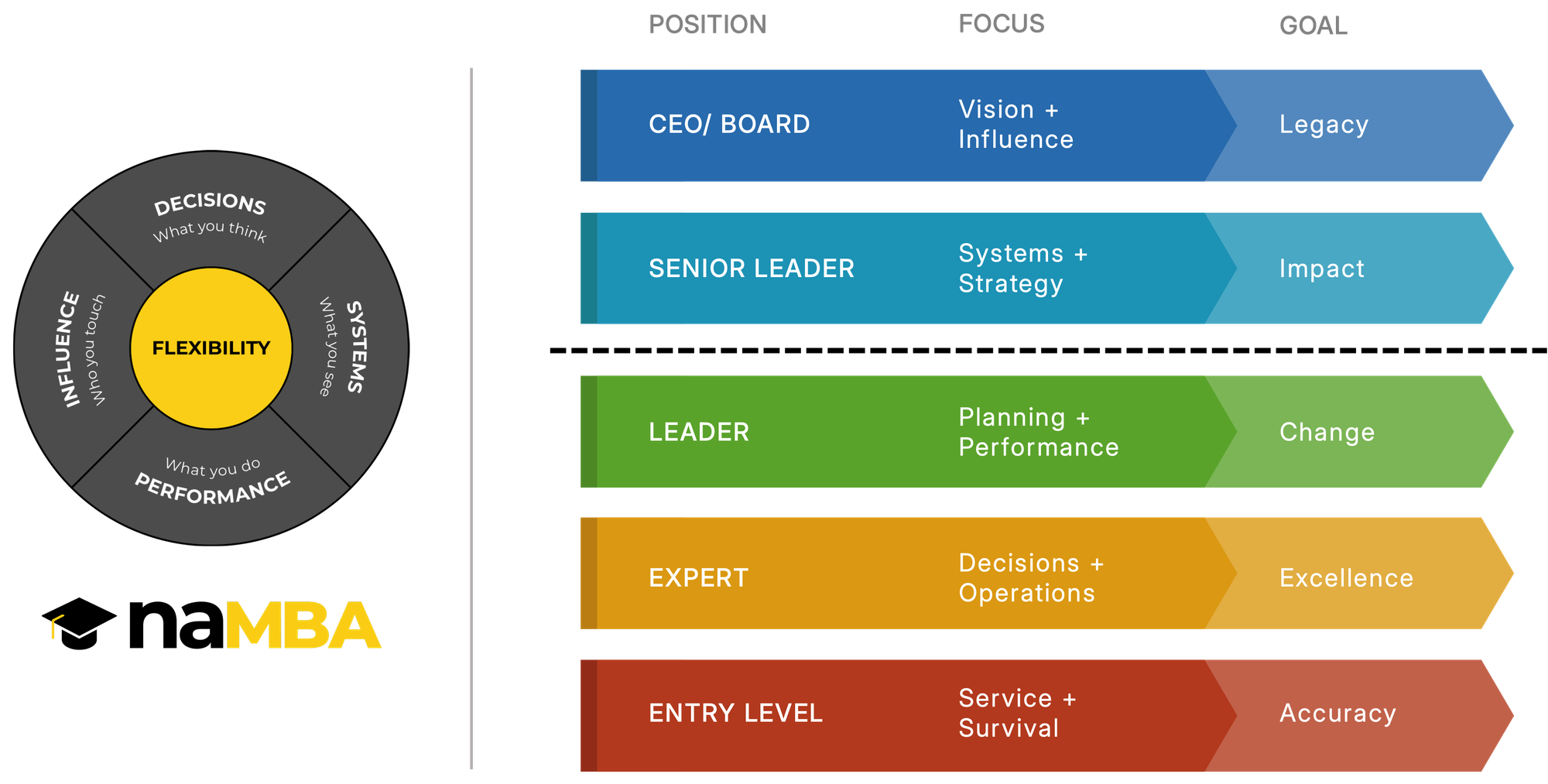
We address this in Not An MBA, using the transition model below to show what happens when you cross the dotted 'rip' into senior leadership. To get to the other side (without staying up nights doing grunt work) requires a paradigm shift. In the blue levels, your value isn't about what you know, or even what you do. Instead, it's about how you see, what you ask, and how you enable others. Judgement, critical thinking and connection.
Two qualities of Subjective Era leadership
Leadership in the Subjective Era will protect and cultivate two interconnected qualities: trust and human agency.
As companies lay off staff and treat customers like idiots or hostages, an opportunity emerges for leaders and organisations with the foresight and integrity to go against the automation and enshittification grain.
Trust as an operating principle
Trust isn't a nice-to-have. Low-trust environments are slow and expensive - think airport security, ID checks, and 2FA. As we get more fragmented and cynical, we risk rising transaction costs, low productivity and weak organisational resilience. Without trust, organisations and communities don't function. People become isolated and conspiratorial, government loses its legitimacy, transaction costs rise and cooperation is difficult.
Breaching trust is costly and risky
Right now, governments, leaders and companies are pouring fuel on the distrust fire. Customers are exhausted from years of price gouging, surveillance capitalism and platform enshittifaction. Service is turning to shit and accountability is disappearing. Technology, once fun, has become a mandatory and resented intermediary to our basic daily tasks.
Many panicked and short-sighted organisations will follow the crowd. Scared of missing out or losing relevance, they'll scramble for efficiencies, surrender their thinking, processes and relationships to technology, and destroy any trust they might still have from employees and customers. The implications are dire.
- Leaders afraid of losing their job don't take risks or generate long-term value - they slip down the leadership ladder into survival mode.
- Staff treated like prompt machines don't take initiative, innovate, or put the customer first. They become low-morale card-punchers.
- Customers who are disappointed, surveilled, trapped and price gouged don't stay loyal. They check out.
- Students and staff encouraged to surrender their cognitive sovereignty don't become great thinkers and engaged citizens. They become unquestioning rule-followers.
Trust-building is everyone's job
Trust building is not just a job for politicians. In fact, according to the 2026 Edelman Trust Barometer it is business leaders who should rise to the occasion.
While people lose faith in government and the media, employers still hold a position of trusted authority in people's lives - they're close to the ground, personally accountable, and tangibly important. If you lead people, you have a unique opportunity to drive meaningful progress.
How to build trust-based organisations
The more trust you build in your organisation, the better and cheaper things run, and the more adaptive and innovative you can be. Here are four ways to do it.
1 - Structure for peer-based trust
Industrial-era organisations designed for standardisation, hierarchy and efficiency. In the Subjective Era, this won't work. Trust has shifted from authorities to peers, which has implications for how you structure your teams and interact with your customers and citizens.
Peer-based trust as a design principle requires flatter structures, co-design, more interdisciplinary teams, and meaningful customer and citizen participation.
2 - Promote a trust-enhancing culture
Even high-functioning organisations battle the impact of economic changes, job uncertainty, chronic stress, remote working and rolling change on their trust levels.
In this article from 2021, I suggest a suite of interventions to shift toward a high-trust environment - including practical steps such as setting achievable goals, communicating more openly, being more social, giving clearer direction and rewarding unity.
These are not just personal characteristics. Culture is an output. Shifting into systems thinking means looking at policies, processes and enablers. We can't ask for unity while measuring performance by individual KPIs or making it difficult to share a cost code. We can't expect clear direction when our strategy is a pretty document we pay lip service to.
3 - Require moral integrity
Technical failures are forgivable, but the tainting effect of moral compromise is harder to recover from. Acting with integrity - publicly and privately - is good business. The Ethics Premium demonstrates the short-term profitability and long-term resilience of organisations who operate with integrity.
"Ethical business practices drive long-term value. Companies committed to integrity are better positioned to attract investment, build stronger relationships with customers and partners, retain top talent and navigate risks more effectively. Transparent and accountable companies also operate with greater stability and are better equipped to identify emerging risks early. Fighting corruption is good for business and essential for shaping competitive, resilient markets."
- UN Global Compact
4 - Operationalise your values
Ethical business isn't about Blu-Taking your values charter to the wall. It requires trust-producing systems: transparent structures, fair process, participative decision-making and policies that demonstrate visible values alignment. It will feel slow, until it doesn't. Truly ethical companies will lean into equity and transparency at exactly the time DEI has gone out of political fashion.
The business case for human agency
Agency is bigger than "empowerment". Agency preserves our ability to think for ourselves, exercise judgement, influence outcomes and retain independence. Right now, organisations are doing the opposite: automating decisions, scripting interactions, surveilling workers and reducing discretion.
This might create efficient systems (debatable), but it destroys the agency of staff and customers and creates a kind of learned helplessness. When we can't make decisions, or speak to someone about our return or complaint who has the power to act, we feel hopeless.
We need critical thinking now more than ever
Critical thinking has topped the list of most important leadership skills for many years. In 2024, I published this piece on the need to hire Arts graduates. Research continues to support this. Benjamin Todd, founder of 80,000 hours, wrote a piece on this for CNBC just last week. His top skills are resoundingly humanist: communication skills, social skills, judgement and decision-making.
AI threatens to replace or erode these very skills, just when we need them most. The most common use of ChatGPT is not coding or automation, it's writing and decision support. But when you remove necessary mental friction and replace your scribbled brainstorms or imperfect emails with AI, you lose the capacity for decisive, aligned action and squander engagement and connection.
When we automate judgement, we risk losing the capability to exercise it. People don't retain skills they don't use. Your cognitive sovereignty is not worth risking.
Do not delegate your brain or mouth
Leaders cannot afford to outsource their capacity to navigate complex decisions with others, or the skills to communicate those decisions effectively. Internally, people need you to explain tradeoffs, contextualise decisions, face up to uncertainty, and speak in terms of values, not just outcomes. Externally, your customers and citizens need you to connect with their lived experience and communicate in stories, values, beliefs and ideas.
For leaders who want to retain trust, there is no short-cut to replace deep thinking and human connection.
How to cultivate human agency
Trust is the foundation of progress, but agency is the engine of it.
The more agency people have, the better they are at solving problems, adapting to change and creating external value. Trust is the foundation of progress, but agency is the engine of it. Here's how to put human agency at the centre.
1 - Design for discretion
While your peers turn to algorithms, be a rebel and give your people real authority over decisions. Show them you trust their judgement, and offer meaningful, tangible pathways to impact. Increase frontline spending authority. Empower people to remediate customer issues. Encourage people to act to the edge of their delegations, and reward those who do. Consistent and responsible use of discretion speeds up transactions, improves customer experience and develops stronger judgement over time.
2 - Keep humans accountable
We are sliding into a dangerous accountability void where invisible systems make life-changing, society-altering choices on our behalf. The consequences of this sit on a spectrum from customer disengagement to political dissatisfaction.
Keep humans accountable for decisions that affect people's lives. Use AI to inform decisions, but don't let it make them. Use standard processes, but put them aside when it's the right thing to do. Make sure humans are on the hook for hiring, strategy, and ethical trade-offs, because neither technology nor bureaucracy should ever replace responsibility.
3 - Remove barriers to power and participation
Agency grows when people know they have the power to influence outcomes. Not consultation. Not feedback. Decision authority. If you want people to 'own' the future, they need a stake in it.
There are layers to this one, and some are harder to implement than others. The obvious ones tackle participation, using things like co-design, citizens panels, staff advisory groups. But for real change, we need more.
The same voices are still systematically excluded from power. The working class, women, gender minorities, disabled people and young people are still being spoken for by the same old faces. If your board, executive team and leadership layer still look the same, you're behind. This ongoing concentration of power is an extraordinary vulnerability in the Subjective Era and it will take more than an inclusion policy to address. Put your money where your mouth is.
4 - Cultivate productive disagreement
We say we want innovation, risk-taking and empowerment. We host inspiring keynote speakers and run hackathons. But when it comes to the crunch, we put harmony before progress and punish people for trying new things.
When was the last time someone disagreed with you and got promoted? Where are your forums for productive disagreement? Where are the guidelines for debate and challenge? If you want curious, engaged people who show initiative, you'll have to eat some risk and tolerate some discomfort.
5 - Invest in strategic skills
Organisations spend a fortune developing technical capability and almost nothing developing judgement. But the most important decisions leaders make involve ambiguity, competing values and imperfect information.
Invest in strategic skills, ethics, systems thinking, critical reasoning, scenario planning and reflective practice. The future belongs to people who can make sense of complexity and chart a path through it.
6 - Reintroduce useful friction
This is a counterintuitive one. For decades, we've been obsessed with removing friction, striving toward an instant, automated nirvana where nobody has to interact with a checkout operator or booking agent ever again.
Yet much of this so-called convenience is a myth. Bright, capable knowledge workers spend their days at the email mill, feeding information into software platforms that only partially speak to each other and fiddling with the back-end of a sticky-taped system that detracts from the real work.
Internalised machine logic has us prioritising the wrong stuff. When we put (false) efficiency ahead of quality, we lose the highest-value friction. Turn the tide on gradual disempowerment and reintroduce productive friction. Write things down. Speak in person. Do things manually. Think in systems. Aim for better, not faster.
7 - Return to the humanities
There is a staggering disconnect between what we require professionally and what we reward culturally. At the precise moment our economy is driven by identity, story, and meaning, we have defunded the humanities, sidelined literature and deprioritised the arts. This is an extraordinary inversion.
Philosophy teaches us ethical reasoning. Literature gives us empathy and narrative. History offers pattern recognition and context. Political science helps us understand legitimacy and authority. Art offers alternative pathways to emotional connection.
Screw the MBA. Put down your screen. Pick up a novel. Read philosophy. Brush up on literature and political theory.
Even better, bring this approach to your recruitment and scrap the automation budget in favour of hiring humanists. In 2026, if you're still hiring and promoting based on technical competence and managerial efficiency, you're slipping behind. The Subjective Era rewards judgement, context awareness, power literacy, emotional intelligence, and interdisciplinary thinking. Hire and develop for those things. (Not coding.)
This is your time to shine
The Subjective Era changes what good leadership looks like. You have the opportunity to build lasting advantage and emerge from this transition in better shape than you started it.
In ten years time, when AI has well and truly enshittified, we won't be supporting the people and companies who vibe-coded a dashboard or panic-fired their customer service teams.
We'll follow the people and organisations who showed us they could be trusted, and who chose long-term human value over short-term optimisation.
Which side you land on is up to you.